Shehbaz lands in China’s tech hub with lofty plans

ISLAMABAD: Prime Minister Shehbaz Sharif arrived in Shenzhen on Tuesday as he kicked off a five-day visit to China.
This is the premier’s first visit to China following the Feb 8 elections, and will likely see the inauguration of the second phase of the China-Pakistan Economic Corridor (CPEC) project and a number of agreements being signed between the two countries.
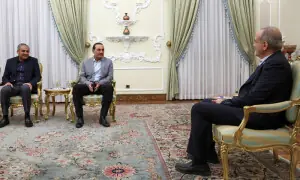
In Shenzhen, which is a hub for innovation, technology and research-led companies, the prime minister met Meng Fanli, party secretary of the Shenzhen Municipal Committee, and Deputy Party Secretary of Guangdong Provincial Committee in Shenzhen, the PM Office media wing said in a press release, as well as leading Chinese companies in innovation and high-tech sectors.
Soon after his arrival, the prime minister took to X, saying that he was “impressed by the city’s skyline and development that symbolises modern day China”.
Engages with local leaders, business community ahead of high-level meetings in Beijing
“Looking forward to my engagements with the provincial authorities, business community and industry giants here before proceeding to Beijing for official talks with President Xi Jinping, Premier Li Qiang and other Chinese leaders and high officials,” he tweeted.
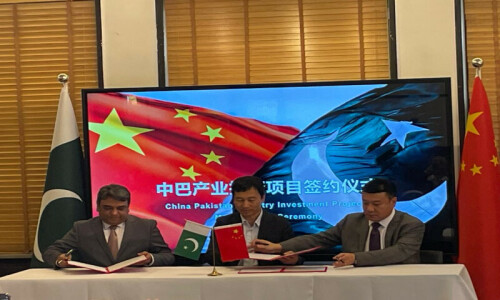
He also inaugurated the Pakistan-China Business Conference in line with his vision to support, promote and lead collaboration between the businessmen of the two countries. A delegation of leading Pakistani business persons attended the conference for collaboration with the influential Chinese counterparts.
Apart from prominent business figures, the Pakistani delegation includes Deputy Prime Minister Ishaq Dar, Defence Minister Khawaja Asif, Planning Minister Ahsan Iqbal, Finance Minister Muhammad Aurangzeb, Petroleum Minister Dr Musaddik Malik, Information and Broadcasting Minister Attaullah Tarar, Food Security Minister Rana Tanveer Hussain, Commerce Minister Jam Kamal Khan, Privatisation Minister Abdul Aleem Khan and Minister of State for Information Technology Shaza Fatima Khawaja.
In a televised statement before his departure, the premier expressed hope that his visit would take the two countries’ bilateral relationship to new heights.
The prime minister said with the support from the ministers, government officers and experts, they would hold talks with the Chinese leadership on multiple subjects.
Both sides would discuss cooperation in multiple sectors like agriculture, information technology, infrastructure, youth skill training, vocational training, industrialisation, Special Economic Zones, expansion and commercialisation of Gwadar Port, mining, and minerals, and sign accords, he said. Discussion on the expansion of the Silk Route through road and sea linkages is also said to be on the agenda.
Earlier, in an interview with representatives of Chinese media groups, including Xinhua news agency, national broadcaster CCTV and CGTN Urdu, the PM said: “We are coming with serious plans.”
Through the visit, he said, Pakistan hoped to promote interaction between enterprises in both countries, utilise Special Economic Zones and Pakistan’s labour advantages to establish joint ventures, facilitate the transfer of industries and technologies, and enhance Pakistan’s manufacturing output, to promote constructing upgraded China-Pakistan Economic Corridor.
He said Pakistan intended to learn from Chinese experiences and build SEZs with the first one to be developed on Pakistan Steel Mills premises already connected with the rail network and located near the port.
He also invited the Chinese companies to build SEZs and enter into joint ventures with Pakistani companies for mutual benefits.
Inviting the Chinese textile sector to set up their units in Pakistan, Prime Minister Shehbaz said that during the visit he would also persuade Huawei to launch short courses for Pakistani youth in information technology and artificial intelligence to make them open their offices and offer their services in the Gulf states and send remittances back to Pakistan.
Similarly, by learning from Chinese agriculture technology, Pakistan desired to multiply its agricultural produce and export them.
Published in Dawn, June 5th, 2024