Opposition protests as KP govt ignores assembly session order

PESHAWAR: The opposition and government in Khyber Pakhtunkhwa are headed for legal confrontation after the government refused to follow the order of the governor, who had called a session of the provincial legislature.
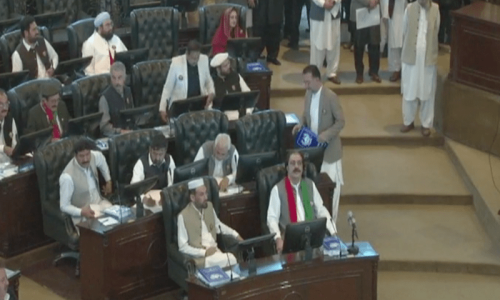
On Friday, opposition members staged a protest demonstration against the government for refusing to call a sitting of the KP Assembly.
They alleged that the government wanted to deprive the women and minority members, elected on reserved seats and notified by the Election Commission of Pakistan, of casting their vote [in the Senate polls slated for next month].
“This is their [women and minority members’] right to take oath. They [Pakistan Tehreek-i-Insaf] want to take four extra seats in the Senate polls,” said Dr Ibadullah Khan of PML-N, who is leader of the opposition in the KP Assembly.
Dr Ibadullah, who was joined by opposition members from other political parties, regretted that on one hand PTI was complaining about alleged changes in Form-45s and Form-47s aimed at depriving them of several seats in the Feb 8 elections, while on the other hand it was itself violating the law.
He said KP Governor Ghulam Ali was empowered to call a sitting of the assembly under Article 109 of the Constitution, adding that 45 members from the opposition parties had requested the governor to call the session.
Mr Khan stated that they came to the assembly, but the offices of Speaker Babar Saleem Swati, Deputy Speaker Suriya Bibi, and secretary, along with the assembly building were locked.
On Thursday, opposition legislators announced legal action against the government for not calling the assembly session after the secretariat didn’t issue a notification for the session even though the governor had issued orders to that effect.
“We are going to the high court [against the provincial government for not calling the sitting on March 22],” PPP lawmaker Ahmad Kundi told Dawn.
Meanwhile, Speaker Swati approached the Law Department seeking to know if the governor’s order was in line with the Constitution.
The speaker’s move came after the governor, on Wednesday, called a sitting of the KP Assembly on March 22 for the swearing-in of members who had been elected to reserved and minority seats and notified by the ECP on March 4, said an official document.
However, the move resulted in a tiff between the governor and the newly-elected government, headed by Chief Minister Ali Amin Gandapur, who described the governor’s actions as unconstitutional.
“The governor can request the speaker of the provincial assembly to call a session, but cannot call a sitting on his own. It is the discretion of the speaker to call the assembly and prepare its agenda,” claimed adviser to the chief minister on information and public relations Barrister Mohammad Ali Saif in a statement.
According to the statement, the government is in contact with its legal team about its response to the governor’s “unconstitutional” order.
The KP Assembly has 30 reserved seats — 26 for women and four for non-Muslims.
The Sunni Ittehad Council, which has 90 PTI-backed members in the assembly, was denied its share of the reserved seats by the ECP.
Those seats went to other parties that have presence in the house, including the JUI-F, PML-N, PPPP, ANP, and PTI-Parliamentarians.
Published in Dawn, March 23rd, 2024