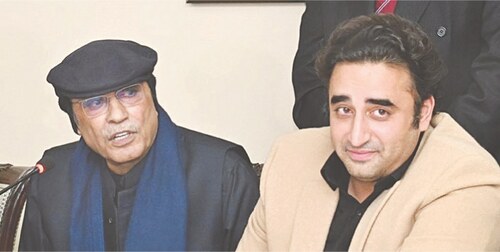
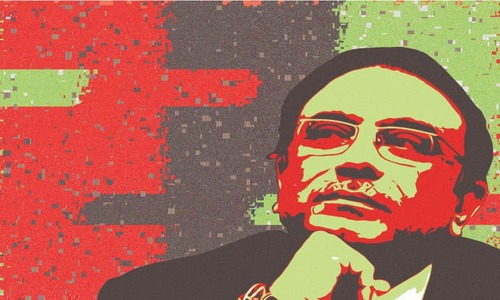
HE was the country’s first civilian president to complete his tenure; now, Asif Ali Zardari’s election as president will make him the first Pakistani to hold that office twice. It is evident that his style of politics has kept currency in the corridors of power despite the many sociopolitical changes this country has seen since the last time he occupied the presidency. It is, undoubtedly, a remarkable comeback orchestrated by a sharp political mind.
According to the public opinion polls conducted in the run-up to the general election and publicised through national media, the PPP was always a distant laggard compared to the PML-N and PTI. With the fortunes of Messrs Asif Zardari and Bilawal Bhutto-Zardari looking modest outside their traditional bastion, most attention had remained on their bigger rivals. Yet, it was the PPP which somehow emerged as the strongest party after the ECP announced its results of the general election, which ensured a split mandate.
Mr Zardari had quietly gained immense leverage over the political configuration due to the bitter acrimony between his rivals. His party offered both the bigger parties an opportunity to form the government, while making it clear its support would require several important constitutional posts in return. When the PTI refused to bargain, the PML-N — whether under compulsion or considering it politically expedient — eventually made the deal.
As a result, the next regime will have a PML-N-led government overseen by the PPP from its constitutional posts. It will be interesting to see how the arrangement will pan out. Though a national unity government had long been presented as a solution to Pakistan’s poly-crisis, those calculations likely did not factor in a large, vocal opposition buoyed by a strong narrative around its victimhood. Such an arrangement also needed a garb of legitimacy, which the recent election was unable to confer.
Mr Zardari is a keen player of the power game and the most successful at it by a fair degree. He had made his way into the presidency for the first time by using a complex strategy that involved using the then army chief to oust Gen Pervez Musharraf from office. He had then kept that office for the full five-year term, despite facing immense pressure from powerful quarters to abdicate. All of his faculties will be required by the new set-up if it hopes to succeed in achieving its goals.
Of course, there are some who believe that the PPP has merely positioned itself to keep its traditional rival on a leash and that it will always put its own interests above anyone else’s. The two have previously worked together, but the PPP also seeks an independent identity under Mr Bhutto-Zardari. It will, therefore, be interesting to see what arrangement the two parties eventually reach.
Published in Dawn, March 10th, 2024