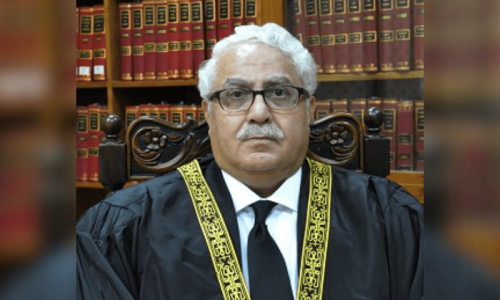
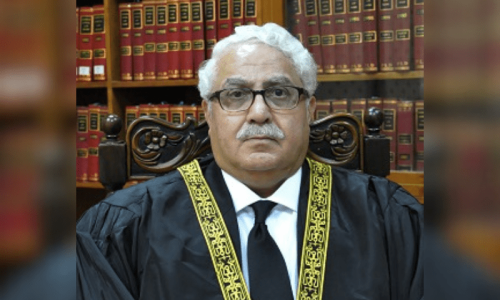
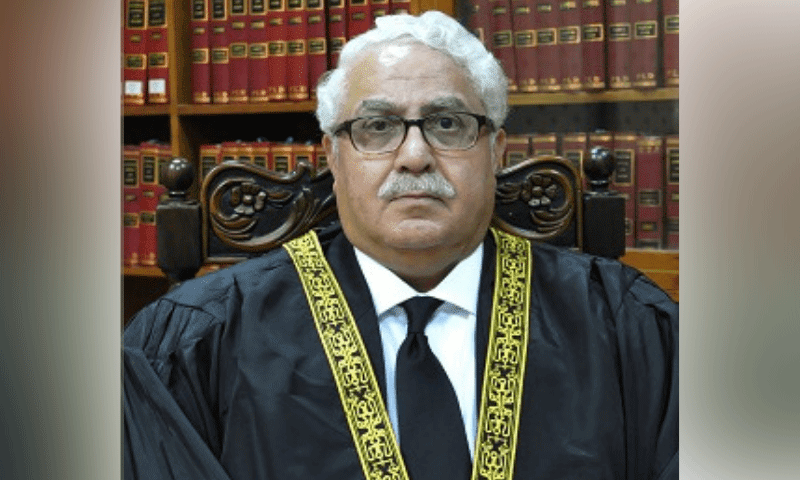
ISLAMABAD: A five-judge Supreme Judicial Council (SJC), in a 33-page detailed reason of its opinion released on Friday, concluded that Sayyed Mazahar Ali Akbar Naqvi was guilty of misconduct and should have been removed from the office of the judge and the honorific ‘Justice’ or ‘Judge’ should not be henceforth used with his name.
The SJC found a number of instances of misconduct committed by the judge, thus, damaging the reputation of the judiciary.
While Mr Naqvi had resigned a day before the SJC began proceedings on nine complaints against him under Article 209(6), the council decided to continue with its proceedings, with Chief Justice of Pakistan (CJP) Qazi Faez Isa saying it was “necessary to remove the misperception that the institution of judiciary is above the law”.
The CJP-headed SJC, however, commended the Pakistan Bar Council (the supreme supervisory body of lawyers) along with the four provincial bar councils and Advocate Mian Dawood, who filed the complaints in a bid to uphold the rule of law and the principle of accountability.
Greed, impropriety, undue advantage among five allegations established against Mazahar Naqvi
Since at least five allegations levelled by the complainants against Mr Naqvi were established, the council said it was constrained to conclude that the respondent had violated his oath of office which required him to abide by the Code of Conduct for judges by violating several provisions of this code.
The council explained that it could not be stated that Mr Naqvi was “untouched by greed”, “was above reproach”, his conduct was “free from impropriety expected of a judge” in his official and private affairs and thus he violated Article II and III of the Code of Conduct. According to the SJC opinion, it was clear that he violated Article IV as his actions were swayed by consideration of “personal advantage”.
He was involved to his personal advantage in the suit filed by Chaudhary Mohammad Shahbaz from whom Mr Naqvi had purchased 100 Saint John’s Park, Lahore, and had knowingly deprived some of their valuable property and thus violated Article VI.
According to Article VI, a judge should endeavour to avoid, as far as possible, being involved, either on his own behalf or on behalf of others, in litigation or in matters which are liable to lead to litigation such as industry, trade or speculative transactions.
To employ the influence of his position to gain undue advantage, whether immediate or future, is a grave fault. A judge must avoid incurring financial or other obligations to private institutions or persons such as may embarrass him in the performance of his functions.
By receiving substantial unexplained gifts, Mr Naqvi violated Article VI since the gifts included receiving Rs50 million, his sons receiving two commercial plots and two residential plots at a nominal price and his daughter receiving £5,000.
The prosecution witnesses such as Mohammad Safdar Khan, a businessman and owner of the Lahore Smart City (Pvt) Ltd Zahid Rafique, the SJC said, tried their best during the proceedings to help Mr Naqvi justify the price for 100 Saint John’s Park and the payment of Rs50 million made by the developer to acquire it. But they utterly failed to state, let alone justify, why a registered company would settle its liability of a substantial amount that it allegedly owed to Mohammad Safdar by not simply paying him the amount, the SJC said. It also noted that for Zahid Rafique, being a longstanding businessman as he claimed he was, and for a well-established company, this was not only inexplicable but also contrary to rudimentary account-keeping and would not be legally compliant.
The SJC said it would not place any credence on the testimonies of both Mr Safdar and Mr Zahid whereas Mr Naqvi offered no justifiable reason in his written reply for doing so and also shied away from testifying. In his reply, Mr Naqvi did not disclose why a company had paid a substantial amount to buy 100 Saint John’s Park, the SJC noted, adding that a judge accepting such largesse from a property developer who claimed he hardly knew him raised very serious questions of propriety. Since no viable explanation for paying the amount was forthcoming, the SJC was left to assume that such incomprehensible generosity to a judge was with the expectation that it would be handsomely recompensed.
The SJC regretted that Mr Naqvi was administered the oath of office on March 16, 2020, by former CJP Gulzar Ahmed and within a period of less than two years, he got four properties, three in Islamabad and one in Rawalpindi.
While the organisations from whom he got the four properties were set up for providing housing to its members, Mr Naqvi did not explain why he obtained the properties when he surely could not reside in all of them, the SJC deplored.
Published in Dawn, March 9th, 2024