THE changes that are taking place in the built environment of Karachi’s low- and middle-income neighbourhoods are hard to ignore by those vested in urban planning. The increase in population, migration, and urbanisation, the rise of the middle class, economic development, and the alterations in the family structure are some of the factors responsible for these changes. For Sindh’s new political set-up, governance in Karachi will be difficult without a deep understanding of the causes of such changes.
Unlike the 1980s and earlier, multi-storeyed dwellings are now a common sight in almost all low- and middle-income neighbourhoods of Karachi. Lyari, Liaquatabad, F.B. Area, North Nazimabad and Gulshan-i-Iqbal are examples. Earlier, in such neighbourhoods, a house comprised two or three bedrooms. One room would be occupied by parents or married couples, and the other rooms by elderly parents and children. They would share a common toilet and bath. With children getting married, the requirement of the rooms increased and resulted in the construction of additional storeys. To earn a stable income, many retirees started renting out a floor, again leading to an increase in the number of floors. Then there is the ‘developer’s capture’ of a neighbourhood, with rundown houses being purchased cheaply, razed and then reconstructed with multiple floors — each floor sold separately and sub-leased.
Earlier, the number of houses in a neighbourhood was limited and residents knew each other well. Lifestyles were simple and residents owned their neighbourhood. The neighbourhood was justifiably called a mohallah, and mohalladari integrated the social life of residents. The bringing up of children was the entire neighbourhood’s de facto responsibility. They kept a check on all children, discouraging them from harmful habits like smoking or delivering a lost shoe to the owner’s house. All this was routine. To share crockery, spices, chairs and charpoys, particularly on special occasions, was nothing unusual. In fact, it was quite the norm.
Karachi neighbourhoods have undergone massive upheaval.
But change was inevitable. Increased levels of education resulted in better-paying jobs, and the desire for a better lifestyle led children to move out of their parents’ neighbourhoods. The second generation of residents in North Nazimabad and F.B. Area moved to Gulshan-i-Iqbal, Bahadurabad, PECHS and even to areas like DHA. Their upward social movement left a gap that was filled by the upward social movement of residents of Orangi Town, Martin and Jamshed Quarters and Old Golimar, for instance. The integration of the newcomers with the old residents was not that quick and often the newcomers were looked down upon by the old residents as ‘upstarts’. With this social movement, gone are the notions of ownership of the neighbourhood, socialisation and the cohesion of neighbours.
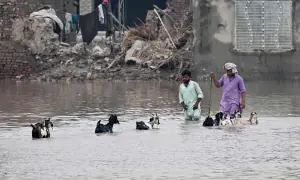
Mismanaging rainwater and urban flooding transformed various neighbourhoods, such as Block 6 of PECHS, into marooned spaces, and private residential spaces gave way to strangers-ridden commercial spaces. Old residents have unwillingly sold their property to developers, who are fast converting residential spaces into godowns, schools, offices, guest houses and private hospitals. This internal displacement is grossly undocumented and needs a robust analysis.
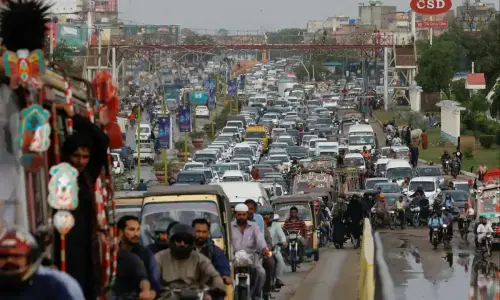
Some 40 years ago, the neighbourhood streets were the grounds where children played hockey and cricket, and the venue for post-dinner strolls by the elderly. Though technology has its share in the changed utility of neighbourhood streets, it all began with growing security challenges, including crime and violence. As a result, the dwellers found themselves restricted to their homes, and the streets were increasingly used for parking vehicles by the residents of the densifying neighbourhood. In fact, the lack of parking space is sometimes a source of violent conflict amongst neighbours.
With such changes taking place in the built environment, traditional places of socialisation were also eliminated. The chabootra outside the house was deserted, the chowk metamorphosed and ruffians took over certain venues. Gone were the socialisation, political debates and the games of cards and chess. Paposh Nagar, North Nazimabad and New Karachi neighbourhoods are examples of such transformation of spaces.
The changing nature of neighbourhoods in Karachi is shaping urban development in the city. It impacts the social life of the city’s residents. To make Karachi more livable, equitable, sustainable, and conducive to the well-being of all its residents, understanding the dynamics of these and many other changes is crucial for urban planners and policymakers.
The writer is a board member of the Urban Resource Centre.
Published in Dawn, March 2nd, 2024