IN his well-researched and comprehensively documented book Pakistan’s Wars: An Alternative History, Dr Tariq Rahman pleads the case for peace. The author’s words are most convincing as they are preceded by a detailed account of the horrors of war that Pakistan has experienced time and again. But will the powers that be, and who have led us into conflict a number of times, take heed? Be that as it may, the fact is that the country stands on the brink of disaster. Those of us who wield the pen should feel morally obliged to reaffirm Dr Rahman’s plea and spread it far and wide.
Dr Rahman quotes Rutger Bregman, a Dutch historian, as saying, “human beings are cooperative and kind by nature as were our hunter-gatherer ancestors. However, our leaders (kings, generals, and politicians) can build upon their suspicions of the out-group to motivate them to wage war”.
Dr Rahman gives numerous examples from world history and from our own accounts of our wars in East Pakistan and with India when individual military personnel on both sides “transcended hatred and vengeance” to show mercy to the “enemy”. He believes that even in war, soldiers are somewhat reluctant to shoot to kill. But he concedes that it would be “naïve and romantic” to believe that wars can be abolished, just because some men in uniform are capable of humane conduct on some rare occasions. He realises that the state “creates a war machine with such tremendous investment and propaganda … that it is not possible that … a suggestion for such a radical change of direction towards peace would even be heard”.
Yet he hopes that some perceptive readers, including policymakers, will realise that the decisions which have precipitated wars have been inordinately risky — akin to gambling. He feels that his book would have served a purpose if policymakers exercise caution when deciding issues that put the very existence of the country at risk.
Efforts to resolve conflicts have been thwarted by hawks.
Well said, Dr Rahman. Here it would be pertinent to remind the readers about the preamble of Unesco’s charter, “Wars begin in the minds of men. And it is in the minds of men that the defences of peace must be built”. Pakistan is not doing amply what Unesco exhorts us to do. Of the hundreds of universities in the country, only a handful — the National Defence University, NUST and the Azad Kashmir University in Muzaffarabad — have a peace studies programme. In some international relations departments, a paper on conflict resolution is included.
However, outside of academia, the Pakistan Institute of Peace Studies has earned a good reputation by making a notable contribution towards promoting knowledge of peace and conflict resolution. Since it uses dialogue as a tool for this purpose it invites leaders of diverse opinion for an exchange of views and disseminates its proceedings widely.
Given the harm that has already been done, these efforts need to be enhanced. Our national ethos glorifies force and violence. As such, our mindset refuses to accept tolerance or compromise and reconciliation in our dealings with people of diverse opinion. The gun culture is rampant. Our national poet Allama Iqbal holds the shaheen (falcon) in high esteem because it is a predatory bird that sustains its aggressive spirit by attacking, turning around and turning around and attacking again, as the poet describes. Our school textbooks glorify our war heroes. Those who propagate peace are hardly ever mentioned.
It is important that this emphasis on war as the only means of resolving disputes and playing up the need for creating a security state for national defence should in fact, be played down. It is time the Foreign Office were given a free hand to formulate a foreign policy that would allow peaceful negotiations to resolve disputes.
We certainly have had some brilliant diplomats who were doves and tried to find peaceful solutions to the disputes that have plagued us. If they failed it was because their efforts were thwarted by our own hawks.
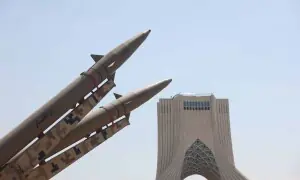
Monuments glorifying weapons, be they swords or submarines, or those signifying the Chaghi nuclear tests should be eschewed. Mercifully, sense has prevailed in some cases and the most lethal of these have been removed. Similarly, the move to celebrate the country’s 1998 nuclear tests every year on what is termed as Youm-i-Takbeer (May 28) has been soft-pedalled, with official backing perceived as being given to some hard-line religious parties who observe the day with all the fanfare they can muster.
The power brokers must understand that the nature of war has changed as non-state actors are involved in every war that is being waged in the world today. These actors do not even observe the international laws of war. Hence the need to promote the spirit of peace to neutralise the war mongering that has become the wont of today.
Published in Dawn, February 23rd, 2024