TBILISI: Armenia said on Tuesday that four of its soldiers were killed by Azerbaijani fire along the heavily militarized border, the first fatal incident since they began negotiating a deal to end more than 30 years of intermittent war last year.
Fatal exchanges have been common along the closed, roughly 1,000 km frontier since 1988 when Armenia and Azerbaijan first went to war over the breakaway region of Nagorno-Karabakh, but the situation had calmed amid peace talks in recent months.
Tuesday’s incident was the biggest since hundreds died when Azerbaijan retook Karabakh in September, prompting an exodus of the region’s ethnic Armenian population.
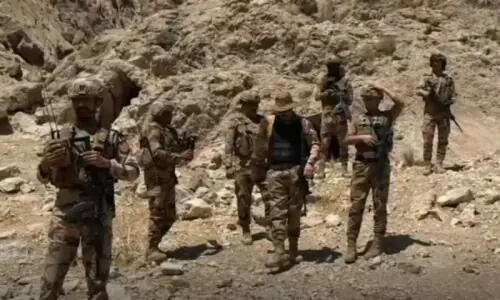
Armenia’s Defence Ministry said in a statement that the four soldiers had been killed and another was wounded at a combat post near the southern Armenian village of Nerkin Hand.
Azerbaijan’s border service said in a statement that it had staged a “a revenge operation” for a “provocation” it said Armenian forces had committed the day before.
“The military and political leadership of Armenia is fully responsible for the incident,” it said, adding that future provocations would face more serious measures.
Azerbaijan’s Defence Ministry said Armenian forces on Monday evening fired at Baku’s positions along a northwestern section of the border, around 400 km from Nerkin Hand. Armenia denied the incident.
In a statement, Armenian ambassador-at-large Edmon Marukyan accused Azerbaijan of “criminal, aggressive behaviour”, and said Baku wanted a pretext to attack Armenian forces.
The Kremlin, which is formally allied to Armenia but also has close ties with Azerbaijan, called for restraint on both sides. A Russian peacekeeping contingent remains in Karabakh and its border guards help patrol Armenia’s frontiers.
The Nagorno-Karabakh region of Azerbaijan had a mostly ethnic Armenian population which won de facto independence after a lengthy war during the collapse of the Soviet Union.
But Azerbaijan in September retook Karabakh in a lightning offensive, prompting a rapid exodus of almost all of the territory’s 120,000 Armenians, and a renewed push from both sides for a deal to end the conflict.
Both Armenia and Azerbaijan have said they want to sign a peace treaty, but disagree over issues including precise demarcation of their border and control over several small territorial enclaves.
Azerbaijan also wants a customs-free transport corridor through Armenian territory, connecting Azerbaijan’s mainland with its Nakhichevan exclave. Armenia has said it must retain control over any transport links on its soil.
Talks have in recent months appeared to stagnate, with both sides accusing the other of sabotaging the diplomatic process.
Published in Dawn, February 14th, 2024