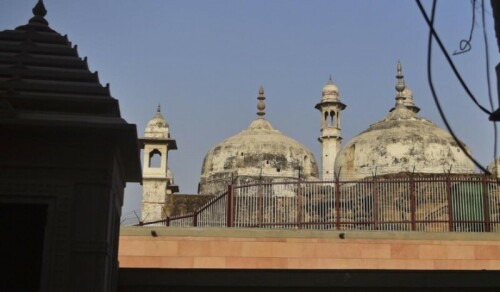
Varanasi, where Hindus travel to cremate their dead by the Ganges river, is the latest flashpoint in a running battle to claim centuries-old Islamic monuments for the country’s majority faith.
Campaigners have found an ideological patron in Prime Minister Narendra Modi, who last month inaugurated a grand new temple on the site of a mosque notoriously demolished by Hindu zealots decades earlier.
“We are witnessing repression and cruelty,” Yaseen, 78, told AFP.
“This is not just the issue of one mosque. Their slogan says that … ‘not even one tomb or mosque will be spared.’”
Yaseen is joint secretary of the Gyanvapi mosque, one of the largest Muslim congregations in the heart of Varanasi.
Hindus in the city have long maintained that the structure was built over a shrine to the Hindu deity Shiva during the Mughal empire that ruled over much of India centuries ago.
Muslim worshippers have been attending the mosque under police guard for years to prevent the simmering dispute from boiling over.
But this week marked a major escalation with a local court ordering the mosque’s basement thrown open to Hindu worshippers within seven days of its ruling.
A Hindu prayer ceremony was held there the following morning and India’s top court has refused to hear a request by Muslim petitioners to invalidate the order.
Yaseen said the ruling and subsequent rush of worshippers to the site, unimpeded by authorities, had demonstrated official backing for the Hindu claim, leaving him deeply distressed.
“They are coming through the courts, through the system,” he said.
“Whatever hurt I could feel as a Muslim, I felt it. I was restless the entire night.”
Tensions outside the mosque on Friday were palpable, with a bolstered police presence and around 2,500 Muslims, nearly double the usual congregation, arriving for afternoon prayers.
Dozens of Hindu faithful milled about the street outside the police barricades shouting devotional slogans to Shiva, the patron god of both creation and destruction.
‘Shackles of slavery’
Calls for India to more closely align the country’s officially secular political system with its majority faith have rapidly grown louder since Modi was swept to office in 2014.
His government’s championing of Hindu causes reached a new zenith last month when Modi presided over the inauguration of a new temple in Ayodhya, a once-sleepy town near Varanasi.
The opening of the immense complex, carrying an estimated cost of $240 million, was a major event that saw public celebrations and weeks of breathless cable news coverage.
Modi hailed the ceremony as a decisive moment in India’s liberation from the “shackles of slavery”.
But many among India’s 210-million-plus Muslim minority considered the gala event as another sign of their growing marginalisation.
The temple was opened on the site of what was once the 500-year-old Babri mosque, which was demolished in 1992 by a crowd of Hindu zealots in a campaign spearheaded by eminent leaders of Modi’s ruling party.
The sectarian riots that followed were the worst since India’s independence and killed 2,000 people nationwide, most of them Muslims.
‘One step forward’
As in Varanasi, Hindu activists had claimed the Babri mosque was built atop an earlier shrine to a Hindu deity during the Mughal empire, which they see as an era where their faith was oppressed.
Sohanlal Arya, a long-time advocate for Hindu causes, said the court’s decision to open the Varanasi house of worship to Hindus was “one step forward” in the campaign to right historical wrongs.
“This is a matter of pride for us,” the 72-year-old told AFP.
“They destroyed our holy place, they made a mosque. Our evidence is accurate. That is why we have full confidence in the courts.”
He added that the struggle to “reclaim” the site had been ongoing since the Gyanvapi mosque was built more than three centuries ago and said that his co-religionists were becoming impatient.
“How much more time will it take? One generation, two generations, three generations?” he added. “We are waiting.”