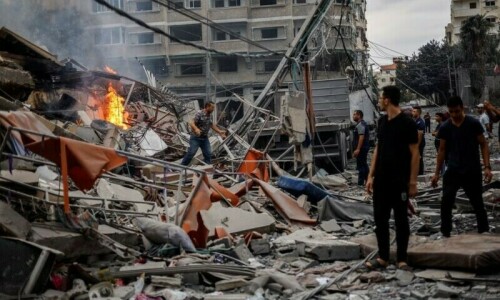
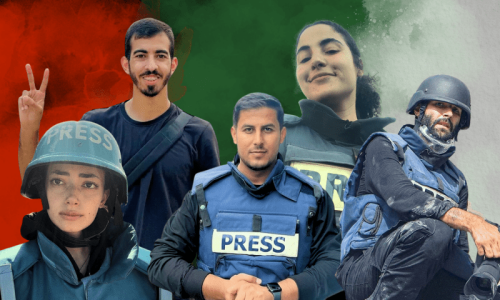
JERUSALEM: Journalists in the Gaza Strip are paying a heavy price to cover the hostilities, with scores already killed and injured.
Those surviving face constant danger from the relentless Israeli bombardment of the Palestinian territory, as well as grappling with communications difficulties, concern for their families and shortages of basic goods.
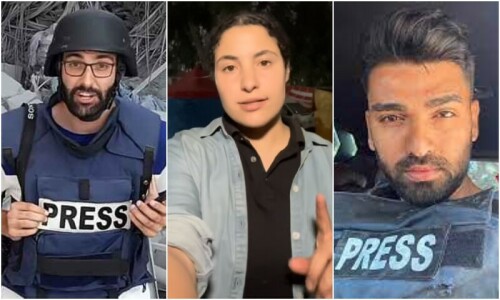
“Our work is to document the war, to let the world know what is happening,” Gazan journalist Hind Khoudary said.
But they know it comes at a cost. On Friday, Al Jazeera cameraman Samer Abu Daqqa became the latest fatality — killed while reporting in southern Gaza.
More journalists have been killed in Gaza over such a short period than in any other conflict in 30 years, said media watchdog Reporters Without Borders (RSF).
According to the Committee to Protect Journalists, 64 media professionals, including journalists, photographers, cameramen, technicians and drivers, have been killed, most in Gaza, since the raids on Oct 7.
Each day is “a question of life or death”, said Palestinian photojournalist Motaz Azaiza.
Some have died in bombardments, at home with their families. Others have died while practising their profession. Three journalists were killed in Lebanon.
Forced to flee
Like some 1.9 million Gazans, Khoudary has had to flee south, leaving behind her office and her home _ “a piece of my heart”, she said.
She set out first for the Al Shifa hospital, where thousands sought refuge, then trekked to Rafah on the closed southern border with Egypt. But she has never stopped documenting “the horrors” of the bombardment.
What is happening in Gaza is “the suffocation of journalism”, said Jonathan Dagher, head of RSF for the Middle East. Even before hostilities erupted on Oct 7, journalists had a tough time in Gaza even under the rule of Hamas, which gained control of the territory in 2007.
“Under Hamas, doing journalism has changed significantly from the situation under the Palestinian Authority”, which is less restrictive, said Adel Zaanoun, a journalist.
“Hamas usually doesn’t object to coverage of Israeli military operations, but completely banned any coverage of its own military activities, including of military posts, weapons and tunnels.”
The group “has also banned any coverage of corruption in their government”, and its “security forces do not condone any criticism on social media”.
Since the fighting began, Rami Abu Jamus, a journalist and fixer for numerous French outlets, has been documenting life in Gaza — “a duty” he calls it.
Losing loved ones
In between videos of bodies and pleas from the wounded, there are others when he plays with his daughter coaxing a smile from her.
Followed by more than 17 million people, photojournalist Azaiza also captures in his pictures and live-streams the distress of the displaced, as well as his own “despair”.
Published in Dawn, December 19th, 2023