0
0

WASHINGTON: Senator Bernie Sanders, former presidential candidate, and a vocal critic of Israeli Prime Minister Benjamin Netanyahu, said on Tuesday he was against giving $10-billion emergency aid to Israel because of its ‘immoral’ military actions in Gaza.
The announcement comes in the wake of reports by a US-based advocacy group, Human Rights Watch (HRW), detailing satellite images of the destruction of agricultural lands in Gaza by the Israeli military.
The White House has called on Congress to approve its aid package for Israel and Ukraine, but Republicans oppose any measure that excludes provisions to address security on the US-Mexico border. And those against the Israeli strategy in Gaza are using this space to block the proposed aid.
Mr Sanders, in his speech on the Senate floor, expressed his concern over appropriating over $10 billion for what he referred to as the “right-wing extremist Netanyahu government.” He minced no words, stating, “I do not believe we should be appropriating over $10 billion for the right-wing extremist Netanyahu government to continue its current military approach.”
Satellite imagery released by HRW reveals destruction of agricultural land in Gaza by Israeli forces
Mr Sanders condemned Israel’s actions as immoral, in violation of international law, and urged the United States not to be complicit in such actions.
The senator, however, acknowledged the importance of US defence, systems like the Iron Dome, protect Israel to but vehemently argued against providing additional unconditional military aid. “I believe that it would be irresponsible for us to provide an additional $10.1 billion in unconditional military aid that will allow the Netanyahu government to continue its current offensive military approach.”
The senator’s objection centers on what he perceives as Israel’s “indiscriminate approach,” which he said was offensive to most Americans. He emphasised the need for a dramatic change in Israel’s strategy against Hamas, marking a departure from his long standing critique of excessive military spending.
Mr Sanders urged Israel to rethink its “indiscriminate approach,” stating, “What the Netanyahu government is doing is immoral, it is in violation of international law, and the United States should not be complicit in those actions.”
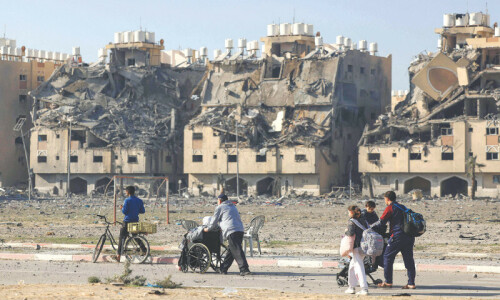
Meanwhile, HRW released damning satellite imagery on Monday, revealing the destruction of orchards, greenhouses, and farmland in northern Gaza.
The report highlighted that the damage occurred since the beginning of Israel’s ground invasion, exacerbating concerns about food insecurity and lost livelihoods. Fields and orchards, initially damaged by hostilities, were further carved up by bulldozers creating routes for Israeli military vehicles.
Senator Sanders’ objections align with the findings of HRW, which depicted a stark transformation of once-fertile land in north-eastern Gaza, illustrating a progression from green agricultural expanses to brown desolation. The destruction persisted even during a week-long truce in Gaza that began on Nov 24, raising questions about the Israeli army’s control and actions during this period.
HRW, in a series of posts on their official Twitter account, expressed grave concerns about the well-being of over two million Palestinians in Gaza facing hunger, food insecurity, and the loss of livelihood due to the collapse of food systems amid the Israeli blockade. The report emphasised the impact on farmers who had invested years in cultivating crops like citrus fruit, potatoes, dragon fruit, and prickly pear, contributing significantly to the livelihoods of Palestinians in Gaza.
As the international community grapples with the complexities of the Gaza crisis, Senator Sanders’ proposed cut in emergency aid adds a new dimension to the ongoing debate. The senator’s stance, encapsulated in his forceful speech, reflects a growing sentiment demanding a reassessment of unconditional military support to Israel. And HRW’s findings intensify the scrutiny on Israel’s actions in Gaza.
The consequences of these developments extend beyond political discourse, directly impacting the lives and well-being of the people caught in the crossfire.
Published in Dawn, December 6th, 2023