0
0

ISLAMABAD: The Sindh government lodged an appeal in the Supreme Court on Thursday against the decision of a five-member bench which had declared ‘unconstitutional’ the trials of civilians under the Pakistan Army Act 1952.
The appeal, filed by the chief secretary, questioned the maintainability of petitions filed against Army Act provisions under Article 184(3) of the Constitution. It also mentioned that the decision to strike down certain sections of the law was in contradiction to the earlier precedents set by the apex court.
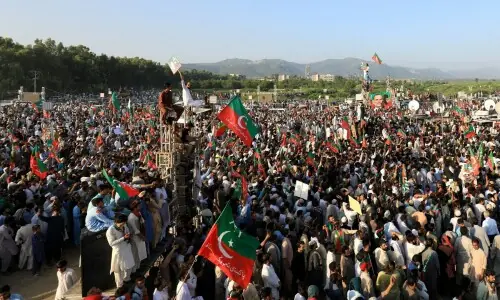
According to the appeal, the petitions were filed in response to actions taken against those who attacked military installations on May 9, following the arrest of PTI Chairman Imran Khan.
“The said attacks appeared to be well coordinated and were meant to affect the morale of the Armed Forces of Pakistan. They were also aimed to create a rift within the armed forces thereby undermining the command and control of the same,” said the appeal, adding that the attacks resulted in damage, destruction and “grave loss to military installations and establishments”. Furthermore, they resulted in injuries to military and other personnel.
The appeal said that the constitution guaranteed the right of peaceful assembly, but this did not “entitle any person to resort to violence or to cause destruction or loss to any property including any military and other sensitive installations and establishments”.
It said that the police lodged first information reports against the suspects and they were taken into custody in accordance with the law. The petitions were filed to challenge the transfer and trial of some of the accused by way of court martial.
Furthermore, the appellant sought the guidance of the top court if “any additional safeguards are to be provided for the preservation of fundamental rights”.
‘Fully compatible’
“Without prejudice to the grounds taken hereunder, it is respectfully submitted that the appellant is fully committed to upholding the fundamental rights, and is, in no manner, arguing that the individuals accused of the incidents of 9th and 10th May 2023, or any other individuals being tried by the court martial are not entitled to the fair trial and due process,” the appeal said, adding: “Instead, the appellant asserts that the court martial established under the army act has at several instances been declared by this court as constitutional and fully compatible with the principles of fair trial and the due process of law.”
The appeal stated that “the army act is immune from any constitutional challenge by virtue of the protection afforded to it by Article 8(3)(a). This principle has been affirmed by this court on several occasions and in some instances by a bench equal to or of a greater numeric strength than a five-member bench.”
Moreover, it pointed out that “the rights of the accused under the army act, the army rules, and the Manual of Pakistan Military Law are in no material manner any less than those of an accused who is being tried by any other ordinary or special court of criminal jurisdiction”.
According to the appeal, the procedural safeguards available in such a case “have also been elaborately discussed” by the superior courts on more than one occasion. But the impugned short order “does not afford any consideration to this crucial aspect of the matter”.
It went on to state that “the decision rendered by a court martial is subject to the filing of a revision before the federal government or the chief of the army staff, as the case may be, and thereafter can also be challenged before the respective high court(s) and the Supreme Court”.
Published in Dawn, November 17th, 2023