Bilawal extends olive branch to PTI

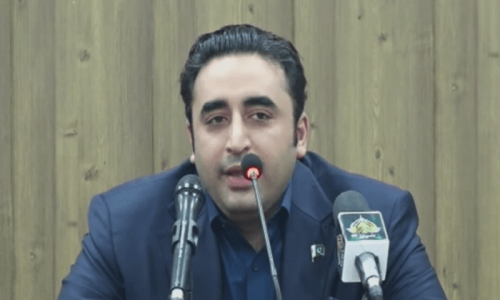
KARACHI: In a conciliatory tone, Pakistan Peoples Party (PPP) chairman Bilawal Bhutto-Zardari on Friday invited the Pakistan Tehreek-i-Insaf (PTI) to join the Charter of Democracy (CoD) signed by two major parties in order to ensure that none of them solicit military support to come to power or to dislodge a democratic government.
While talking to reporters after inaugurating a free diagnostic lab facility under the JDC Foundation, the PPP leader maintained a soft approach for the rival PTI amid election date announcement. He didn’t rule out an electoral alliance with the party, though he didn’t sound very supportive of PTI’s recent attempts to malign state institutions ahead of the upcoming elections.
In response to a question about the possibility of PPP’s electoral alliance with the PTI in Punjab, Mr Bhutto-Zardari said: “We have not yet made any decision in this regard.”
“As far as the Charter of Democracy is concerned, I think all the political parties of the country should come to the CoD, and it will be very good if the PTI also recognises and joins the charter.”
Suggests PTI to join Charter of Democracy; hails elections date announcement
Under the dictatorship of Pervez Musharraf, the then exiled leadership of PPP and PML-N came closer for the first time in their political history and joined hands to sign the CoD in London in May 2006, envisioning the establishment of a new political system of harmony and reconciliation in Pakistan to ensure continuity of oft-derailed democratic system.
Signed by two former premiers Benazir Bhutto and Nawaz Sharif, the document became a source of their joint campaign against the military rule in the country.
‘Welcome to the club’
On the occasion, the PPP chairman welcomed the announcement of election date by the Election Commission of Pakistan (ECP), but reiterated the complaint that level playing field was not available to all the parties contesting elections. Yet he sounded confident that PPP would form the next government.
“All political parties should get a level playing field in the general elections,” he said.
“PPP was never given a level playing field in any of the past elections. Even in 1988 and 2008 [elections], we didn’t have a level playing field, but despite that we secured our mandate and formed the governments. The problem with the PTI is that it demands a level playing field just for itself but no other party. If they [PTI] are facing some difficulties in an election for the first time ever, I would only say welcome to the club.”
On the other hand, Mr Bhutto-Zardari called it a “great achievement” of all political parties that at last the ECP officially announced the date of general elections. But he said it would have been better if the ECP itself had given an election date, and the Supreme Court would not have had to intervene. “Well, whatever happened, it’s done now, the elections should be held on February 8,” he said.
The PPP chairman, however, avoided commenting over the recent statements of his past ally and chief of his own faction of Jamiat Ulema-i-Islam-Fazl (JUI-F) Maulana Fazlur Rehman who still cast doubts over the possibility of general elections.
Rights violation
Meanwhile, the former foreign minister also questioned the way the Afghan nationals who have been illegally staying in Pakistan were being repatriated.
He objected to the process of repatriation, calling it a violation of human rights. The right job, he said, couldn’t be executed the wrong way.
“We are very clear about this and we have a very strict line when it comes to issues related to human rights,” said Mr Bhutto-Zardari.
“There is a proper mechanism to address any illegal activity. But whatever is happening right now we believe that it raises several questions over the process. The law must be followed but in the process, the set rules of human rights shouldn’t be violated.”
Published in Dawn, November 4th, 2023