India launches key test for manned orbital mission


India on Saturday successfully launched the first unmanned trial run of its upcoming crewed orbital mission, in the latest milestone for its spacefaring ambitions.
The Gaganyaan ( “Skycraft “) mission is slated to send three astronauts into Earth’s orbit in 2025, an important yardstick of the Indian Space Research Organisation’s (ISRO) technical capabilities.
Saturday’s rocket tested the emergency escape system of its crew module, which separated from the thruster and made a soft sea landing about 10 minutes after the launch.
“I am very happy to announce the successful accomplishment of the mission,” ISRO chief S. Somanath said afterwards.
The lift-off was postponed for two hours after bad weather and a glitch in the engine.
ISRO will conduct a series of 20 major tests, including carrying a robot to outer space, before the final manned mission takes place in 2025.
Gaganyaan is the first mission of its kind for India and comes with an estimated price tag of $1.08 billion, according to ISRO.
India plans to send astronauts beyond the reaches of Earth’s atmosphere for three days before they are brought safely back with a soft landing in Indian territorial waters.
Prime Minister Narendra Modi has announced plans to send a man to the Moon by 2040 following a year of triumphs for India’s space programme.
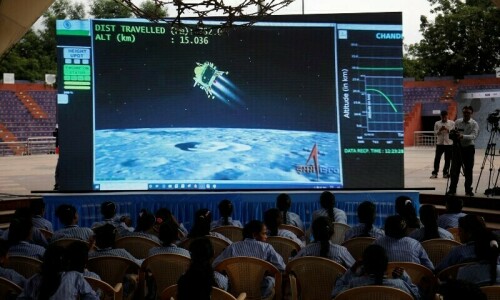
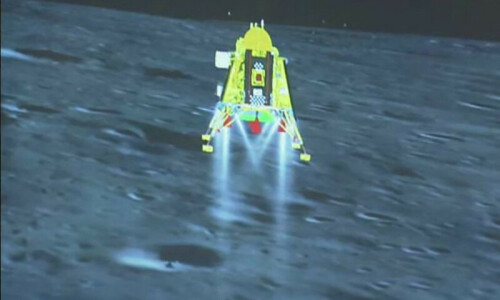
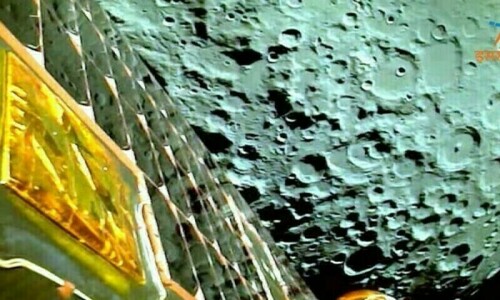
India became in August just the fourth nation to land an unmanned craft on the Moon after Russia, the United States and China.
The following month, India launched a probe to observe the outermost layers of the Sun from solar orbit.
India’s space programme has grown considerably in size and momentum since it first sent a probe to orbit the Moon in 2008, and it has steadily matched the achievements of established spacefaring powers at a fraction of their cost.
India also plans a joint mission with Japan to send another probe to the Moon by 2025 and an orbital mission to Venus within the next two years.
Experts say India can keep costs low by copying and adapting existing technology, and thanks to an abundance of highly skilled engineers who earn a fraction of their foreign counterparts’ wages.