0
0

ISLAMABAD: A weak stance from Pakistan or the rest of the Muslim world on the situation in Gaza could lead to a public backlash, experts and former diplomats have opined.
The former ambassadors were speaking at a roundtable conference titled ‘Geostrategic Conundrums: A Comprehensive Analysis of the Hamas-Israel Conflicts Impact on Pakistan’, organised by Islamabad-based think tank, the Pakistan Institute for Conflict and Security Studies (PICSS).
The event was attended by Pakistan’s former envoy to Egypt Mushtaq Shah, PICSS Managing Director Abdullah Khan, former high commissioner to Sri Lanka retired Maj Gen Saad Khattak and NUST Assistant Professor Dr Farah Naz, according to a statement issued on Sunday.
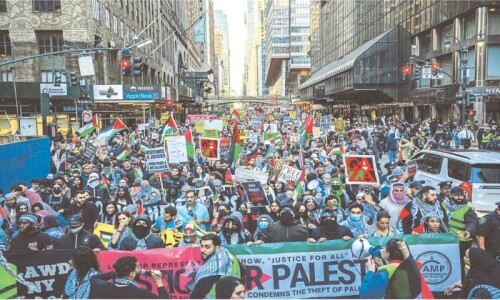
“A weak stance on the Palestine issue may result in a public backlash in Pakistan, and the government should let the public vent out its anger, and for that matter, other Muslim countries should also let the public vent out anger and frustration,” according to ex-ambassador Shah.
Saudi-Israeli peace deal termed ‘first casualty’ of attack; expert says pressure over standing with Palestine might harm Pakistan’s fledgling economy
He warned that if people in the Muslim world weren’t allowed to protest, “they might overthrow their governments”.
Mr Shah argued that Pakistan has no bilateral dispute with Israel. “It supports the Palestinians based on the principle of decolonisation and common faith,” he said, adding that Pakistan need not get directly involved in the current conflict.
The former ambassador called the peace deal between Saudi Arabia and Israel “the first casualty of the Hamas attack”.
“In the current situation, no normalisation with Israel is possible by Pakistan or any other country,” Mr Shah added.
Mr Khattak said that neither the Pakistani government nor the people could support the killing of innocent Israelis by Hamas.
“But in the same spirit, friends of Israel should come forward and condemn the butchering of Palestinian people in Gaza by the Israeli occupying forces,” he demanded.
He, however, criticised Pakistan’s official stance on the current situation in Palestinian territories and said that the country’s official position was “very weak” and didn’t reflect the aspirations of the people.
Mr Khattak said the current conflict “did not build overnight”, but it has been brewing since 1948. He also criticised Western media’s double standards regarding the coverage of the conflict.
Professor Naz emphasised that, like the US and China, Pakistan should adopt a diplomatic tone when dealing with the complex matter. She said the Israel-Palestine conflict was a highly sensitive subject.
“Pakistani hearts beat in support of Palestinians. That is the prime reason the [Foreign Office] took such a stance,” she said while referring to a statement in which the FO called for a ‘two-state solution’ to end the hostilities.
“Standing with the Palestinian cause will put a huge pressure on a struggling economy like Pakistan. Therefore, Pakistan should go for a diplomatic resolve by engaging international law and international organisations,” she added.
Mr Khan, the PICSS managing director, shared insights into the potential impact of the conflict on international militant groups.
He said that some people feared another wave of migration of militants from different parts of the world towards the Middle East, especially from the Pak-Afghan region.
According to Mr Shah, this was not likely to happen as per his assessment. He argued that global jihadi migrations in the past were always linked to Western geostrategic goals, whether it was the Afghan Jihad in the 80s or subsequent conflicts in Balkan and Caucasus region in the 90s or recent conflicts in Syria, Iraq and Libya.
Published in Dawn, October 16th, 2023