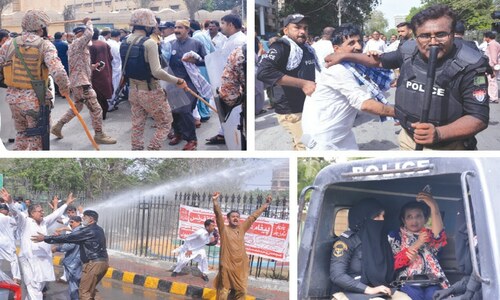
LAHORE: Thousands of teachers across Punjab are resisting the caretaker government’s decision to privatise 1,000 public schools in Punjab and amend the pension regulations.
By holding protests and strikes in the major cites as well as the districts, they are demanding the government revoke its decision to hand over the schools to the Muslim Hands Pakistan, a non-governmental organisation (NGO).
In response, the caretaker government, formed to hold general elections, has launched a crackdown, arresting hundreds of protesters. The main operation occurred in Lahore on Oct 12 where the teachers from across Punjab had gathered along with other government employees to hold a sit-in outside the Civil Secretariat to force the government to change its decision.
The Punjab Teachers Union (PTU) claims that the government is planning to privatise 10,000 schools, not 1,000, and that it is targeting the schools with the best infrastructure, doling them out to the private sector.
PTU officer-bearer Rana Liaqat has told Dawn the privatisation of public schools would affect the quality of education and deprive the poor students of their right to inexpensive education. He says the government schools are providing free and multiple admissions to the students throughout the year while the NGOs will charge fees and limit the admissions to just once a year. He says the government schools are facing a shortage of teachers and that new recruitment can solve this problem.
Mr Liaqat adds that the government is transferring the teachers of the privatised schools to other schools and offering them early retirement, which would demoralise the teachers and affect their performance. He says the previous government had also handed over some schools to the NGOs but those projects failed as the private organisations could not manage the schools and left.
The PTU leader raises the question why the government doesn’t hand over the schools with poor infrastructure to the NGOs so that they could build it or improve it. He fears that the current step taken by the caretaker government would result in further deterioration of the school education in the province and urges the government to stop the privatisation process.
The protesters also raised the question whether the caretaker government had the powers to take such a big decision which would affect hundreds of thousands of schoolchildren, belonging to the lowest strata of society, and thousands of teachers.
Caretaker Chief Minister Mohsin Naqvi had issued orders on Sept 10 to hand over 1,000 public schools of the province to the Muslim Hands Pakistan after signing a memorandum of understanding (MoU). He had met a six-member delegation of the private organisation, led by its Chairman Syed Lakht Hasnain, at the Chief Minister’s House when he made the announcement. He claimed that the standards of education at the government schools would be raised in collaboration with the private sector and welfare organisations. He said the minimum two to three public schools from every district of the province would be made centres of excellence like Daanish Schools.
A School Education Department officer, on condition of anonymity, has told Dawn that the government is planning to hand over more schools to the NGOs in the future. He says the teachers of the privatised schools will be transferred to other schools and they will also be offered special incentives for retirement.
When the teachers protested against it and held a sit-in outside the Civil Secretariat, the Lahore police and district administration launched a crackdown on them and arrested 250 protesters, including women teachers, on Oct 12. However, the protesters continued their protest in different areas of the province on Saturday and vowed to continue their protest until the government took back its decision.
It’s worth mentioning that the government would hand over all related assets of schools to the private organisation, including expensive land, huge buildings, playgrounds and laboratories, collectively worth billions of rupees, in the centres of the cities across the province. The infrastructure took decades to build at the expense of huge public funds. It is said that once, the keys to these public schools are handed over to the private sector, the government would end all direct control.
The teachers’ organisations say that this is the start of privatisation of the public schools in the province and the process has been launched by a caretaker setup, whose primary responsibility is holding general elections and not making important policies. The scale of the decision can be gauged from the fact that 350 government schools would be handed over to the organisation in just one division of Rawalpindi.
Published in Dawn, October 15th, 2023