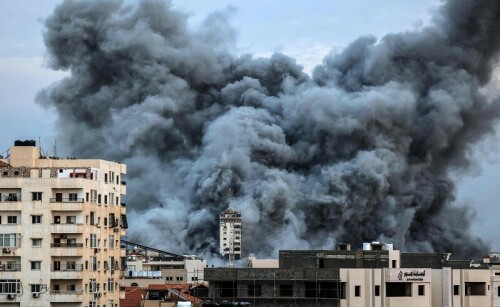
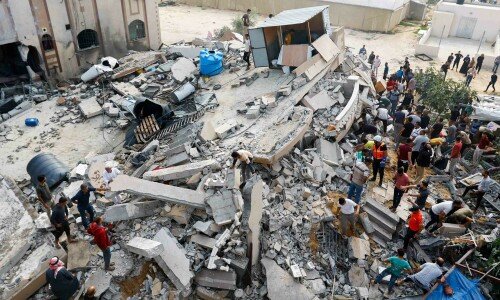
US will always have Israel’s back, says Biden

WASHINGTON: United States President Joe Biden said on Saturday the US will always have Israel’s back and warned that no enemy of Israel should exploit the attacks.
Talking to Israeli Prime Minister Benjamin Netanyahu, he offered “all appropriate means of support” to the government and people of Israel in their fight against Hamas.
“The United States unequivocally condemns this appalling assault against Israel by Hamas terrorists from Gaza, and I made clear to Prime Minister Netanyahu that we stand ready to offer all appropriate means of support to the government and people of Israel,” President Biden said in a statement issued after he spoke with Mr Netanyahu.
“My administration’s support for Israel’s security is rock solid and unwavering.
“Terrorism is never justified. Israel has a right to defend itself and its people,” he said
“We are heartbroken by the lives that have been tragically cut short and hope for a swift recovery for all those who have been wounded,” President Biden said. “My team and I are tracking this situation closely, and I will remain in close touch with Prime Minister Netanyahu.”
Palestinian President Mahmoud Abbas, however, told US Secretary of State Antony Blinken that “injustice” towards Palestinians is driving the conflict with Israel to an “explosion”, according to Palestinian news agency WAFA.
In a phone call, Abbas also said the ongoing escalation is down to the “practices of the colonialists and the Israeli occupation forces, and the aggression against Islamic and Christian sanctities,” according to WAFA.
In New York, UN Secretary-General Antonio Guterres urged all parties to make “diplomatic efforts to avoid wider conflagration,” adding that “only a two-state solution” could bring peace to the region.
Stéphane Dujarric, a spokesman for the UN secretary general, said Mr Guterres has called for the immediate release of all abducted persons and “urges all diplomatic efforts to avoid a wider conflagration.”
The secretary-general “stresses that violence cannot provide a solution to the conflict, and that only through negotiation leading to a two-state solution can peace be achieved.”
The New York Times noted that “the issue of Israelis in captivity is a deeply emotional and explosive one in Israel.” In 2006, Gaza militants seized an Israeli hostage and held him for five years until he was exchanged for more than 1,000 Palestinians from Israeli prisons.
As the Atlantic magazine pointed out, the ‘critical strategic’ question being debated in Washington is: How this conflict, and especially an extended one, impacts long-term efforts to build on the Abraham Accords and possibly normalise relations between Israel and Saudi Arabia?
The United States has been trying to negotiate a wide-ranging deal to get Saudi Arabia to agree to diplomatically recognise Israel.
“Israel will have some bandwidth from the international community in the coming days to launch a retaliatory strike. But the longer a war goes and the more carnage there is, the international community will begin to call for all sides to de-escalate,” says Jonathan Panikoff, the director of the Scowcroft Middle East Security Initiative in the Middle East Programmes.
Mr Panikoff, one of the authors of the Atlantic’s opinion piece, argued that Jerusalem was unlikely to accede to requests for peace “unless it views that it has achieved at least some of its objectives”.
And while Saudi Arabia may be privately supportive of Israel’s efforts to take on Hamas, “the Arab street is not likely to be so supportive, especially as images from television, print, and X highlight death and destruction in Gaza and potentially Lebanon,” he wrote.
Published in Dawn, October 8th, 2023