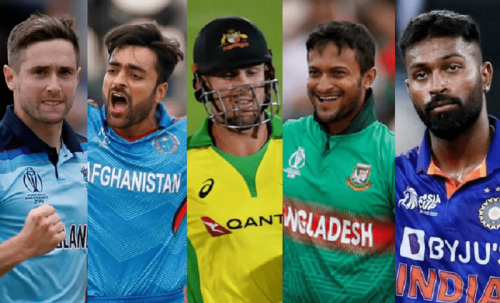
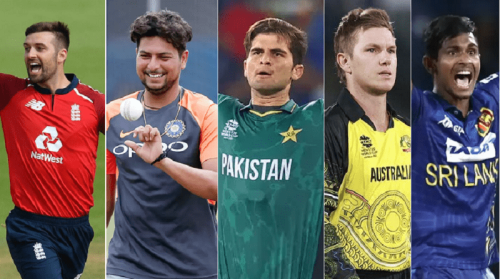
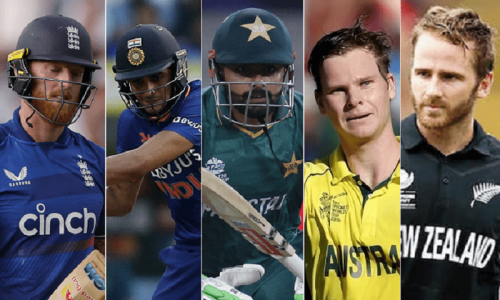
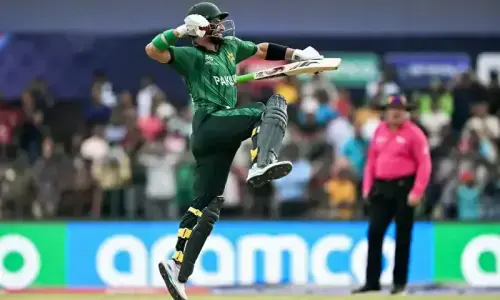
LONDON: The World Cup which gets underway on Thursday will provide a sharp focus for one-day international cricket and a chance to show how the 50-over game has evolved since India last staged the tournament in 2011.
One of the criticisms of ODIs, once the economic driving force of the global game, is that they are too often reduced to ‘meaningless’ bilateral series.
The format is also viewed as too pedestrian in the slipstream of the high velocity, smash-and-grab Twenty20 format.
“The ODI has been reduced to virtually depending on a World Cup year for its importance,” wrote former Australia captain Ian Chappell in a recent ESPNCricinfo column.
Meanwhile, India great Sachin Tendulkar, a 2011 World Cup winner, believes the format is now too formulaic.
“The game is becoming too predictable,” he said. “From the 15th to the 40 over, it’s losing its momentum. It’s getting boring.”
And yet the ODI remains a key plank of the International Cricket Council’s schedule, with the 50-over format still capable of providing an entertaining spectacle.
Perhaps the biggest on-field development since 2011 has been the change in what constitutes a big total.
There have been 24 occasions on which 400 has been passed in ODI cricket and 15 of those have come since the 2011 World Cup The 2011 final saw India reach a target of 275 with just 10 balls to spare.
But in an age where World Cup-holders England have lifted the world record for an ODI total to 444 in 2016, 481 in 2018 and 498, against the Netherlands, last year, 275 rarely represents a challenging target.
Yet for all the prevalence of shorter boundaries and the impact of the wider range of shot-making developed by T20 cricket on all other formats, ODIs are not always run-fests.
The very length of a 50-over game allows for the possibilities of both bowlers getting on top and teams recovering from a top-order collapse.
England were 55-5 in an ODI against New Zealand at Southampton last month but still managed to post a total of 226-7 in a match reduced by rain to 34 overs per side.
And they won by the large margin of 79 runs after dismissing New Zealand for 147, with left-arm quicks David Willey and Reece Topley taking three wickets apiece.
Even so the days when 300 was considered a significant ODI total do seem to belong to an earlier age, although the sheer pressure of a World Cup gives ODIs an edge lacking in bilateral series.
Indeed the greatest off-field change since 2011 is the number of people questioning whether the ODI has much of a future outside of a World Cup.
Incoming MCC president Mark Nicholas believes all other ODIs ought to be on the way out.
“We believe strongly that ODIs should be World Cups only,” Nicholas told ESPNcricinfo. “We think it’s difficult bilaterally now to justify them. They’re not filling grounds in a lot of countries. And there is a power at the moment to T20 cricket that is almost supernatural.”
He added: “In a free market, the most money wins. And that’s just the end-game.
“The players can see that bubbling away and they want to be a part of it.
So, it is an extraordinary power that T20 has, and I think scheduling 50-over cricket alongside it just continues the story of the death knell of the ODI game.”
ODIs, which date back to 1971, are not going anywhere anytime soon, however.
And the World Cup will feature at least one match between India and Pakistan — a fixture which is effectively being kept going by ICC tournaments while political interference prevents bilateral matches between the arch-rivals.
Published in Dawn, October 4th, 2023