
ISLAMABAD: The Ministry of Finance (MoF) has highlighted policy implementation, higher sovereign guarantees and poor performance of state-owned entities (SOEs) as potential risks and uncertainties that could impact the country’s fiscal outlook while record inflation rates posed heightened risks to the country’s external stability.
In its latest Fiscal Risk Statement (FRS) 2023-24, the ministry has noted that federal government exposure to SOEs, in the form of outstanding stock of loans and guarantees, stood at 9.7pc of GDP in FY21, and public and publicly guaranteed debt stock reached 78.4pc of GDP at the end of FY22.
It said the external debt, which entailed currency risk, constituted about 37pc of the total public debt. The fixed-rate debt portfolio has decreased in recent years and currently stands at only 26pc of total public debt, increasing refinancing risks. Furthermore, the average time to maturity of domestic debt was 3.6 years for FY22.
The FRS 2023-24 focuses primarily on macroeconomic shocks, debt and guarantees, climate and natural disasters, SOEs and public-private partnerships (PPPs) given that these represent the most important fiscal risks facing the government. Among them, policy implementation and SOE have been highlighted as high risks.
Amid challenges emanating from global factors — supply chain issues, inflationary trends and prolonged Russia-Ukraine war — the report said the hikes in the central bank’s policy rate to fight inflation continue to weigh on economic activity.
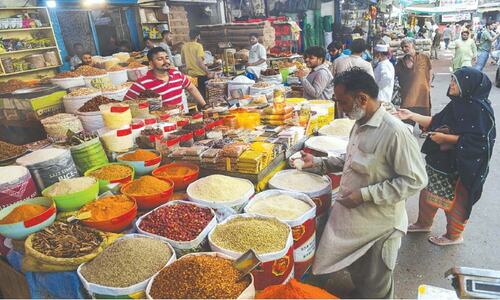
The inflation rate in Pakistan has been volatile in recent years, influenced by various factors such as currency devaluation, energy, and food prices in the global market.
“The Pakistani rupee has experienced significant depreciation in recent years, influenced by various risk factors such as trade imbalances, external debt, political instability, and global economic conditions”.
The pace of economic activity during FY23 has been significantly constrained due to several factors, such as demand compression measures, losses in agricultural production caused by floods, uncertainty regarding the resumption of the IMF programme, a difficulty in meeting external financing needs and maintaining foreign exchange reserves, it said.
“The inflation outlook has deteriorated, and there is a heightened risk to external stability,” the FRS said, adding that the uncertainty surrounding the future adjustment path in energy prices is the main upside risk to the inflation outlook. However, a potential moderation in international commodity prices may contribute to a reduction in inflation while the government aims to reduce the fiscal deficit by implementing measures such as expanding the tax net, rationalising subsidies, and promoting economic growth.
“External debt constitutes 40.8pc of total public debt, which may make the government’s fiscal position vulnerable in the face of high current account deficits, low foreign exchange reserves, and a weakening exchange rate,” the ministry said. A lack of foreign exchange reserves coupled with large external payments has resulted in liquidity issues and destabilised the exchange rate and domestic interest rates, further increasing the burden of external loans that are measured in local currency, it pointed out.
Ongoing fiscal deficits require refinancing of the government’s maturing debt while raising additional debt to fulfil the fiscal shortfall. A high level of short-term debt creates potentially significant refinancing challenges during periods of slower economic growth, higher fiscal deficits, and/or lower investor confidence.
Another source of fiscal risk is reflected in Pakistan’s exposure to floating debt, making it vulnerable to increase in borrowing rates that may arise due to unfavourable economic conditions. The share of a fixed rate in domestic debt was 26pc and around 70pc in external debt.
The Ministry of Finance is working with the State Bank of Pakistan (SBP) and the Securities and Exchange Commission of Pakistan (SECP) to develop domestic debt capital markets and increase the participation of other entities such as insurance companies and pension funds.
The stock of guarantees stood at 4.5pc of GDP in FY22. Guarantees issued against commodity operations are not included in the estimated stock now in annual limits imposed on new issuances, on the basis that the loans are secured against the underlying commodity and are essentially self-liquidating.
The outstanding stock of commodity operations was Rs1.134 trillion at the end of June 2022. A fiscal risk arises from the fact that a significant part of commodity operations lacks underlying collateral due to issues like theft of commodities, unpaid subsidies, and wastage during storage.
Pakistan’s SOE universe comprises a total of 204 SOEs, of which 85 are categorised as commercial enterprises. Overall, SOE revenues in FY19 were approximately Rs4tr, while their book value of assets was Rs19tr.
The government guarantees to SOEs have increased in FY21 relative to FY16. While commercial SOEs are expected to be a source of revenue for the federal government, in the form of taxes and dividend payments, net inflows have been negative.
One of the key drivers of SOE fiscal risk arises from the absence of a clear and comprehensive framework for public sector obligations (PSOs), which would allow SOEs to be properly compensated for undertaking quasi-fiscal activities. The erosion of the SOE’s profitability, capacity to invest and financial viability arising from such activities may not become fully apparent for years.
“Overall, SOEs provide essential services in several sectors to many vulnerable consumers, making the complete elimination of quasi-fiscal burdens on SOEs politically and economically infeasible,” the ministry said.
Published in Dawn, September 2nd, 2023