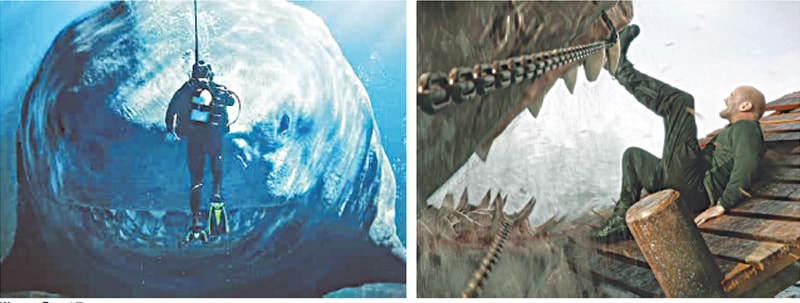
Otodus megalodon, the biggest shark of all time, has long captured the imaginations of palaeontologists and the public alike. Scientific fascination spawns from the sheer enormity of their fossilised teeth. As big as human hands and serrated like kitchen knives, they were used for cutting down whales unlucky enough to encounter these sharks.
This gigantic predator has been further propelled into the limelight through popular culture. Nowhere has the megalodon made a bigger splash than its starring role in 2018’s The Meg, followed by a sequel this year, Meg 2: The Trench.
Adapted from the bestselling novel Meg: A Novel of Deep Terror by Steve Alten, The Meg tells the story of a group of scientists discovering megalodon living in the Mariana Trench in the western Pacific Ocean.
The film is undeniably riddled with scientific inaccuracies. However, I can’t help but appreciate The Meg. A ridiculous film? Yes. But everyone involved seems very aware of this, making for highly entertaining viewing.
Meg 2 and the truth about the extinct mega shark — and why even this ridiculous fi lm could inspire future palaeontologists
In my professional opinion, if a future palaeontologist becomes inspired and makes new megalodon discoveries because they saw this unserious film, then its existence has surely been a good thing.
I feel this way because it is ultimately my own story.
The very reason I discovered megalodon was because I watched a media depiction of it — specifically the BBC documentary series Sea Monsters (2003), in which zoologist Nigel Marven visits prehistoric seas in his time-travelling boat to dive with ancient beasts.
I was just six at the time. I am now, 20 years later, a practising palaeobiologist specialising in fossil sharks and my most well-known work revolves around none other than megalodon.
Megalodon biology and cinematic representation
The Meg does take artistic licence with available scientific knowledge. For example, the sharks are portrayed at exaggerated sizes of 27 metres (88 feet). The most recent scientific extrapolations from tooth size, however, estimate a maximum size of 20 metres (65 feet) long, still making it one of the largest predators that have ever existed.
Some dismiss megalodon’s appeal as beginning and ending with its humongous size. Nothing could be further from the truth.
For starters, this shark was everywhere. Its fossil teeth occur in geological formations on six continents dating across 20 million years during the Miocene and Pliocene epochs (23 million years ago to around 3 million years ago).
Intriguingly, some of those formations were shallow habitats with lots of small megalodon teeth: tell-tale signs of nurseries where the babies were left to grow with plenty of food and protection from predators. One such site is Panama’s Gatun Formation, which is referenced in The Meg.
Unravelling megalodon’s predatory ecology from fossils is even more interesting.
Its enormous teeth have left behind nasty injuries on whales that fell victim to its massive bite force, including baleen whales and even sperm whales.
Using 3D modelling around a 140-vertebrae spinal column, researchers have made stomach volume calculations that suggest megalodon could eat predators the size of today’s killer whales in just a few bites.
Recent chemical analyses from teeth have also produced compelling findings. Nitrogen isotope values from megalodon are exceptionally high, indicating it was higher up the food chain than any living marine predator. In short, the megalodon was the most apex of ocean predators.
Oxygen isotopes in fossils demonstrate higher body temperatures than the surrounding environment. This indicates mesothermy — an ability to maintain high body temperatures seen in only a few species such as great whites, mako sharks and basking sharks.
Mesothermy enhances swimming speeds, allowing a megalodon to travel faster and further, increasing its chances of finding prey. This active lifestyle would have forced megalodon to eat more food — around 98,000 kcal every day — to justify its size.
As such, the loss of its coastal habitats and associated prey would have limited food intake and possibly starved it into extinction 3 million years ago.
Meg 2 features a slightly different ecology. It depicts a megalodon devouring a Tyrannosaurus rex. The shark first evolved more than 40 million years after non-avian dinosaurs went extinct so, unfortunately, this clash of the iconic beasts would never have happened in reality. It is, however, a nod to Steve Alten’s original novel that also featured such a fantastical scene. And it makes for a very cool moment of cinematic absurdity.
A better story for sharks
Notably, The Meg portrays megalodon as surviving into the present day. This is impossible, because the fossil record shows that the disappearance of the apex super-predator megalodon had a cascading effect on the ecosystem. It caused the spread of great white sharks, for example, and allowed whales to get even bigger because there were no more giant sharks to fear.
Unfortunately, media depictions like this can drive bizarre conspiracy theories that megalodons are somehow still alive. This is, of course, nonsense, but isn’t necessarily the fault of The Meg. Fake documentaries using actors as scientists are far more guilty than a silly Hollywood movie.
Would I like to see films that accurately use all available science to depict such a remarkable shark? Of course. But entertainment is what it is.
Sharks continue to be portrayed negatively in the wider media, despite up to a third of today’s sharks being threatened with extinction.
So, if Hollywood is going to continue portraying living megalodons, then I feel the most interesting aspect of this fictional scenario has yet to be properly explored: would we be far more dangerous to megalodons than they would be to us? I think the answer is a resounding “yes”.
We kill as many as 100 million sharks every year and the largest ones are at particular risk. This could be a powerful story to help explain the importance and vulnerability of today’s sharks to modern audiences, the same way The Meg and its sequel brings attention to the biggest shark of all.
The writer is a doctoral researcher in Palaeobiology at Swansea University in the UK Republished from The Conversation
Published in Dawn, ICON, August 27th, 2023