Canada wildfires force tens of thousands to flee


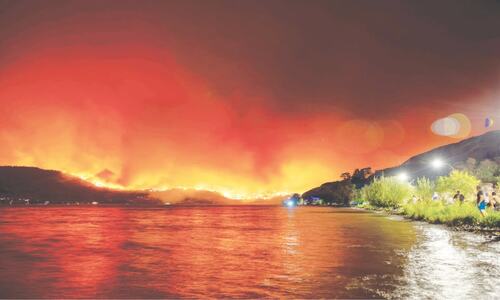
KELOWNA: Officials in western Canada’s British Columbia implored tens of thousands of residents to heed warnings and evacuate on Saturday as “rapidly evolving” wildfires threatened large parts of the scenic Okanagan Valley, including the city of Kelowna.
The situation in the popular boating and hiking destination was “highly dynamic,” said Bowinn Ma, the province’s minister of emergency management.
Around 30,000 people were under evacuation orders while another 36,000 were under alert to be ready to flee, she said.
“We cannot stress strongly enough how critical it is to follow evacuation orders when they are issued,” Ma said at an afternoon news conference.
Blazes in the Northwest Territories have led to evacuation of regional capital Yellowknife
“They are a matter of life and death not only for the people in those properties, but also for the first responders who will often go back to try to implore people to leave.” Kelowna, a city of 150,000, was choked with thick smoke as it became the latest population centre hit in a summer of dramatic wildfires across Canada that has left millions of acres scorched.
Prime Minister Justin Trudeau said he had spoken with British Columbia Premier David Eby about the “rapidly evolving and incredibly devastating wildfire situation” and pledged federal resources in responding to the disaster.
Blazes far away in the neighbouring Northwest Territories have meanwhile prompted the evacuation of regional capital Yellowknife, leaving the remote city of some 20,000 largely a ghost town.
Winds have been fanning the wildfires towards Yellowknife, but Saturday saw some relief after overnight rain brought a sharp dip in temperatures.
However, “a little rain does not mean it’s safe to come back home,” warned Northwest Territories
environment minister Shane Thompson at a Saturday evening press conference.
“Though the surface may not show fire, it’s still active and it’s huge,” he said, noting that temperatures are expected to rise again on Sunday.
Yellowknife official Chris Greencorn praised the work crews were doing to build defences around the city, with large areas cleared to create firebreaks and pipes laid for sprinklers and water cannons.
“Basically this represents approximately two full Yellowknife construction seasons completed in less than six days,” he said.
‘Incredible’ exodus
Tony Whitford, a former commissioner for the Northwest Territories and a longtime resident of Yellowknife, arrived in the city of Calgary on one of the first flights out and gave the evacuation high marks.
“My compliments to them all,” Whitford, who is 82 and wheelchair-bound, said of the organisers. “It’s so complex — 20,000 people — it’s incredible.
It went smoothly.” Several towns and Indigenous communities were evacuated earlier. The exodus from Yellowknife and elsewhere means two-thirds of the near-Arctic territory’s population has been displaced, Thompson said.
The ongoing fires have caused “terrible loss,” Trudeau told reporters after meeting Yellowknife evacuees Friday as they arrived in Edmonton, Alberta, with no idea when they may return home.
About 40 flights carrying around 3,500 passengers from Yellowknife have arrived in Calgary, said officials in the city, which has made nearly 500 hotel rooms available.
In British Columbia, blazes have already destroyed several properties in West Kelowna, separated by Okanagan Lake from its larger, eponymous neighbour.
Among them is the Lake Okanagan Resort, according to local media, which is known for having hosted high-profile politicians such as British prime minister Margaret Thatcher.
Eby on Saturday announced an emergency order halting non-essential visits to the area.
Published in Dawn, August 21st, 2023