0
0

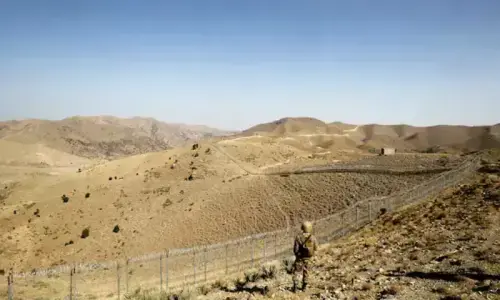
PESHAWAR, Feb 1: Members of the NWFP Assembly on Wednesday demanded that the tribal areas administration should ban the entry of armed Afghan tribesmen who migrated in winter from Afghan provinces and settled down in the province.
Speaking on his unanimously adopted resolution, Israrullah Khan Gandapur informed the house that Afghan Koochis known as Pawindas or migratory tribesmen used to come down from their hilly provinces during the harsh winter and return with the beginning of the spring.
For centuries, Afghan gypsies would run the cycle of their life in this pattern to avoid the wrath of winter, but for some years, now, they had been bringing weapons with them, which was the source of a permanent trouble, he added.
He said that during skirmishes, Afghan shepherds used guns and killed local people. He said they journeyed via Waziristan and settled in and around the villages of Gandapuri area.
Mr Khan said he had two FIRs in record, which the local people had registered against Afghans tribesmen. It was the duty of political administration in the tribal agencies to take their weapons at the entry point and return them when they went back, he added.
He demanded that the NWFP governor should order the political agents of tribal agencies to take measures in the light of resolution for the rule of law in the respective agencies abutting on Afghan provinces.
He also asked the government to deploy platoons of the Frontier Constabulary in and around the Gandapuri areas of D. I. Khan for the protection of life and property of the locals.
Law and Parliamentary Affairs Minister Malik Zafar Azam, who hails from Karak district, informed the house that two areas of his district, Bahadarkhel and Gurguri, were also faced with the similar problem. These two areas should be included in the resolution, he said.
Earlier, on a call attention notice Imtiaz Sultan Bukhari of the Pakistan Muslim League (Nawaz) drew the attention of the house to what she called organization of unnecessary political meetings and rallies on busy roads and markets, blocking traffic flow for hours in the city.
She demanded a ban on political meetings and rallies on roads and market places.
Minister for Local Government Sardar Mohammad Idrees said they were a political government and could not put a ban on political activities. Political parties were free to hold meetings and rallies across the province, however, they would be asked not to organize gatherings at the busy and congested places.
While tabling an adjournment motion, Makhdoom Mureed Kazim of the Pakistan People s Party (S) asked the government to regularize the services of contract employees, who had been serving this province for many years.
He said the minister had assured them on the floor of the house that the services of contract employees would be regularized, but now the government was not taking any step on the issue.
Provincial Minister Sardar Idrees said these were regular posts and the government could neither recruit them nor regularize their services. These employees would have to go through the public service commission. The chair, however, kept it (motion) pending till the detailed answer from the treasury benches.
Earlier, speaking on the problems of the survivors, Wajihuzzaman Khan of the Pakistan Muslim League extolled the efforts of the federal and provincial governments and said 85 per cent people had been paid compensatory amounts. He asked the government to pay the compensation to the rest 15 per cent people.
Rifat Akbar Swati of the PPP (S) reiterated her old demand and asked the government to provide land to the survivors for construction of houses. She said poor people had no land where they should construct houses.
Provincial Minister Sardar Idress said international donors had emphasized the accountability and transparency during doling out amounts, however, the NWFP government had given compensation to each and every affected person.
Later, Speaker Bakht Jehan Khan, prorogued the session.