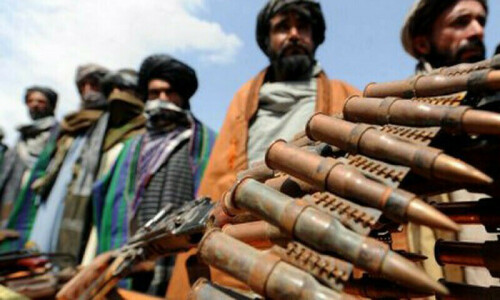
UNITED NATIONS: The banned Tehreek-i-Taliban Pakistan (TTP) might be seeking a merger with Al Qaeda to create an umbrella organisation that shelters all militant groups operating in South Asia, warned a monitoring report submitted to the UN Security Council.
“Some [UN] member states registered concern that TTP might provide an umbrella under which a range of foreign groups operate, or even coalesce, avoiding attempts at control by the Taliban,” the report added.
The report, compiled by a UN committee that monitors terrorist activities across the globe, endorsed Pakistan’s complaint that the banned TTP has increased its influence in Afghanistan since the Taliban takeover.
“One member state noted the possibility of [Al Qaeda] and TTP merging. It assessed [Al Qaeda] to be providing guidance to TTP for conducting increased attacks within Pakistan,” the report warned.
Kabul rejects UNSC report claiming Al Qaeda presence in Afghanistan
According to the document, training camps run by various terrorist groups in Afghanistan’s Kunar province are being used by fighters of the banned TTP as well.
“Since the reunification with several splinter groups, and emboldened by the Taliban take over in Afghanistan, TTP has aspired to re-establish control of territory in Pakistan.”
UN monitors noted that the proscribed TTP remained focused on high-value targets in border areas and soft targets in urban areas.
“TTP capability is assessed as not matching its ambition, given that it does not control territory and lacks popular appeal in the tribal areas,” the report added.
The UN committee reported that in June, certain elements of the banned TTP were relocated away from the border area, as part of the Taliban’s efforts to rein in the group under pressure from the government of Pakistan.
Member states told UN monitors they were concerned that the outlawed TTP could become a regional threat if it continues to have a safe operating base in Afghanistan.
The UN committee, which submitted its report to the Security Council on July 25, shed light on how the banned TTP was gaining momentum in Afghanistan since the Afghan Taliban took control in August 2021.The report also highlighted how other terrorist outfits were using the TTP cover to operate in the war-torn country.
“The distinctions between members of Al Qaeda and affiliated groups, including TTP, and [IS-K] are at times blurred at the edges, with individuals sometimes identifying with more than one group and a tendency for people to gravitate towards the dominant or ascending power,” the report noted.
“There is growing reporting that other sanctioned terrorist groups are using support to TTP as a means to evade control by the Afghan Taliban,” it added.
The document defined Afghanistan as a place of global significance for terrorism, with approximately 20 terrorist groups operating in the country and spreading their influence across regions and to build theocratic quasi-state entities.
The UN committee observed that relationship between the Taliban and Al Qaeda remains close and symbiotic. For the most part, Al Qaeda “operates covertly in Afghanistan to help promote the narrative that the Taliban comply with agreements not to use Afghan soil for terrorist purposes”.
Under the patronage of high-ranking officials of the de facto Taliban authorities, “Al Qaeda members infiltrate law enforcement agencies and public administration bodies, ensuring the security of Al Qaeda cells dispersed throughout the country”.
It estimated that the Al Qaeda core in Afghanistan remains stable at 30 to 60 members, while all Al Qaeda fighters in the country were estimated to be 400, reaching 2,000 with family members. Al Qaeda in the Indian Subcontinent had approximately 200 fighters.

Afghanistan’s Taliban rulers, however, have rejected the UN report as incorrect. “The UN Security Council report is not true. Al Qaeda has no presence in Afghanistan,” Zabihullah Mujahid, the primary spokesperson for the Afghan Taliban, tweeted on Friday.
Published in Dawn, July 29th, 2023