Judiciary can’t make laws, can help with implementation: CJP

• Justice Mazhar says pending cases increasing due to population growth
• Asks CJP to seek report on recommendations of population conference
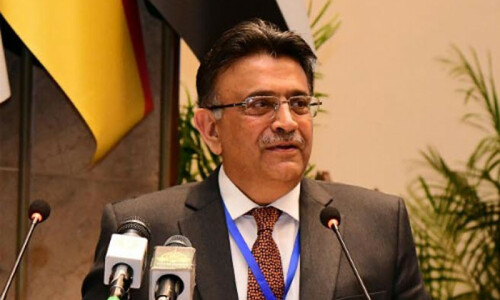
ISLAMABAD: The judiciary cannot make laws or policies, but it can issue directions to enforce them if they are not implemented, Chief Justice of Pakistan Umar Ata Bandial said on Saturday.
“As judges, we all support the enforcement of laws, but the way forward will always be to call the courts to come in aid in case the government was reluctant or doing nothing to execute the laws,” Justice Bandial said at the closing session of a two-day conference titled ‘Resilient Pakistan: Calibrating Population and Resources’, held at the Supreme Court’s auditorium.
The conference was also attended by judges of the Supreme Court, high courts and superior courts of Azad Jammu and Kashmir and Gilgit-Baltistan.
CJP Bandial observed that very progressive legislation had come into the field in this regard in Sindh and Khyber Pakhtunkhwa over population issues.
But the prime step which needed to be taken was that the proponents of the population issue approach the respective governments to enforce the laws, he said, adding the high courts could be approached of laws were not implemented.
The chief justice stressed the need to enforce fundamental rights of women like the right to life, health, education and employment.
“The first observation as a judge I will make is that there is a window the participants have opened during the last two days, which is the enforcement of laws as well as policies of the government that promote the population management,” CJP Bandial emphasised.
One of the key takeaways of the event, he said, was that it had been dominated by many talented women.
“Half of my concerns on the subject of population stands addressed here,” he said, adding the conference has highlighted that we had many capable, intelligent and informed women at high positions who are the engines and prime movers of development in the field we were talking about.
One of the main highlights on the second day of the conference was a theme song — ‘Gar nahi paal saktai tou roko zara’ — by singer and social worker Shehzad Roy.
“The real issue is not changing the laws, but the mindset of the people, Mr Roy, the brand ambassador on the population and family planning, said, urging the government to lift the ban on contraceptive ads imposed in 2016.
He said his organisation, Zindagi Trust, was working on a strategy to introduce legislation on a reproductive health care course among young people planning to get married.
During the conference, Justice Muhammad Ali Mazhar of the Supreme Court observed that the purpose of the event was not to formulate policies by overstepping the domain of the legislature but to highlight grey areas with collective wisdom.
He acknowledged that the rapid population growth was adversely affecting the judiciary since the docket of the judges was full of frivolous or petty matters like issuance or blocking of national identity cards, or cases related to voter lists or the release of pension and gratuity.
Such cases filled the courts of the district judiciary to such an extent that it had become difficult to complete the entire roster in a single day. Such difficulty also points out the fact that our authorities were not performing their duties according to the law and in the spirit of the civil service demanded from them.
Justice Mazhar also requested the CJP to obligate the Law and Justice Commission of Pakistan — a government body responsible for developing and improving the country’s legal system and recommending reforms in laws and statutes — to furnish a report on how much lawmakers and policymakers had taken the recommendations of the conference seriously.
One of the speakers, Dr Durre Nayab of the Pakistan Institute of Development Economics, noted that China and India were never considered densely populated despite huge populations because both had created a balance between population and resources.
Published in Dawn, July 16th, 2023