At UN rights body, FM Bilawal condemns Holy Quran’s desecration as ‘attack on faith’


Foreign Minister Bilawal Bhutto-Zardari said on Tuesday that the desecration of the Holy Quran amounted to the incitement of religious hatred as the UN Human Rights Council debated a motion in the wake of a recent incident of the holy book’s burning in Sweden.
Last month, a man desecrated the Holy Quran in Sweden’s capital Stockholm, resulting in strong condemnation from several Muslim states, including Pakistan, the Organisation of Islamic Cooperation, the European Union, Pope Francis and the Swedish government, among others.
In response to the incident, a motion was brought by Pakistan that sought a report from the UN rights chief on the topic and called on states to review their laws and plug gaps that may “impede the prevention and prosecution of acts and advocacy of religious hatred”.
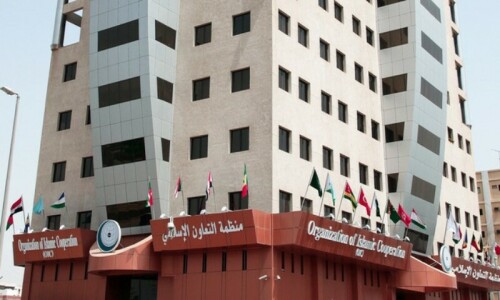
It highlighted rifts in the UN body between the West and a Muslim grouping, the Organisation of Islamic Cooperation, with Western members concerned about its implications for free speech and challenges posed to long-held practices in human rights protection.
During the debate on the contentious draft today, other Muslim nations also joined Pakistan in condemning the act and called for accountability.
For his part, Bilawal said while referring to the Holy Quran’s desecration, “We must see this clearly for what it is: incitement to religious hatred, discrimination and attempts to provoke violence.”
Addressing the session via a video link, he said “the deliberate desecration of the Holy Quran has continued under the government sanction and with a sense of impunity” and that such acts were designed to “maximise provocation”.
“We must join hands in condemning it and, we must isolate those who stoke hatred,” he stressed.
Bilawal added that “it is important to understand the deep hurt that a public and premeditated act of the Holy Quran’s desecration causes to Muslims. It is an attack on their faith”.
Bilawal further said the call made in the motion for prevention and accountability over such acts was “reasonable and necessary”, adding that he was not losing sight of the fundamental right of free speech in making this demand.
“Free speech is as indispensable as hate speech should be indefensible. Our vigour to protect free speech must not lose sight of the imperative to reject hate speech,” he asserted.
Bilawal said no Muslim country allowed the desecration of holy texts of other religions, adding that such an act was “unthinkable” to any Muslim and “forbidden by faith, by culture and by law”.
“It is in the same spirit I resolutely stand alongside those who are calling for prevention, legal deterrence and accountability of actions that constitute incitement of hostility against people of faith.
“Let us unite against hatred, discrimination and intolerance and forge pathways for mutual respect, understanding and intolerance,” he said, concluding his address.
Bilawal’s remarks were echoed by ministers from Iran, Saudi Arabia and Indonesia with the latter calling the Holy Quran’s desecration an act of “Islamophobia”.
“Stop abusing freedom of expression,” said Indonesian Foreign Minister Retno Marsudi. “Silence means complicity.”
Germany’s ambassador Katharina Stasch called the burning a “dreadful provocation” and condemned it. But she added that “freedom of speech sometimes also means to bear opinions that may seem almost unbearable”.
France’s envoy said human rights were about protecting people, not religions and their symbols.
UN Human Rights Chief Volker Turk told the 47-member council that inflammatory acts against Muslims, as well as other religions or minorities, are “offensive, irresponsible and wrong”.
But, he continued, these were “complex areas” and care needs to be taken in setting legal limits on free speech, which could be abused by those in power.
Diplomats said intense negotiations had not led to a breakthrough on Tuesday and expect a vote. Such a vote would almost certainly pass since OIC countries make up 19 members of the 47-member body and also have support from China and others.