0
0


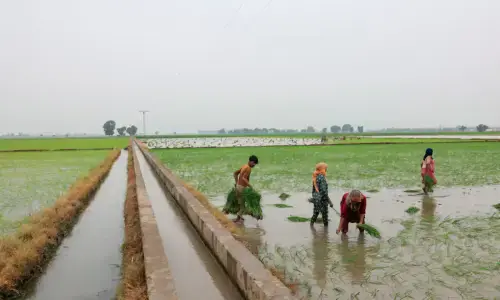
ENVIRONMENTAL displacement can hardly be quantified; however, the severity of the crisis can be grasped by glancing at some staggering statistical figures.
For instance, according to the Ecological Threat Register, a 2020 report published by the Institute for Economics and Peace, a Sydney-based international think tank, ecological disasters displace an average of 24 million people per year, and if the current rate continues, there would be at least 1.2 billion people displaced globally by the end of 2050.
Karachi’s natural heritage ranges from shorelines, backwaters, rivers and nullahs, to old gardens, parks, private lawns, migratory birds’ routes, and, most importantly, the historical trees indigenous to the city, which include the neem, peepal, keekar and especially the banyan tree for its sacred memories.
These trees are located mostly in old neighbourhoods, which preserve the memories of this city. In 2019, along with other activists, the Natural Heritage Association of Karachi lobbied for the designation of the centuries-old banyan trees as ‘protected heritage’ in partnership with the local government. Then administrator Murtaza Wahab declared the Old Clifton banyan trees and others in Karachi ‘heritage protected’ under a legal framework.
Around 30 trees out of 64 were pruned, registered, and preserved. And the rest of the mapped banyan trees of Old Clifton were left for the next phase — to be part of the next project — as a complete annexure; they were declared the ‘Banyan Trees of Old Clifton’ on a signboard next to Do Talwar. The non-preserved, neglected trees are still waiting for their preservation plan.
The real estate boom is uprooting Karachi’s foliage.
Over the years, banyan trees have witnessed moments of transformation and resilience. In recent times, the regrowth and maintenance of these trees have lessened because of Karachi’s worsening air quality and the lack of governance in maintaining the natural heritage. But the main reason is the real estate boom, which has been invasively uprooting the foliage of the city and replacing it with concrete pavers and trees that are merely beautifying elements.
The latter include date palms, which are meant to be a part of the Dubai-esque development that the authorities aspire to, the conocarpus, and aggressively grown green barriers meant to conceal informal settlements or a non-picturesque view in the vicinity of a new development.
Natural heritage foliage is mostly found in old neighbourhoods of the city, where generations of mohalla dari have taken ownership through care management, and where self-elected neighbourhood associations have nurtured these large natural markers. But it’s unfortunate to see how much neighbourhoods like PECHS, PIB Colony, Tariq Road, Garden East and West, KDA Scheme No 1 and Soldier Bazaar have suffered at the hands of low-grade developers and the corrupt government organisational management.
Karachi’s fractured infrastructure and constant expansion and development have resulted in unequally distributed planning powers. A very large city — 40.69 billion square feet (3.8bn square metres) — Karachi expanded continuously during 2000-2020, recording an average annual growth rate of 4.7 per cent — an unmanageable scale.
It is critical that we protect natural heritage even while expanding the city, as we see some of these trees being cut down in order to construct buildings, or being neglected. This is leading to the destruction of the natural environment and habitat.
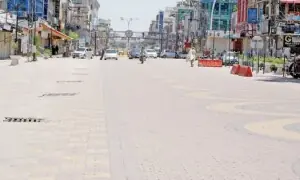
These developers, following unethical architectural practices, have contributed to a humanitarian crisis, where malpractice, easy turnkey projects, and industrial material for mass construction have altered climatic conditions, resulting in high temperatures and heated corridors of circulation. This has made walking or waiting for public transport unbearable.
The city provides an opportunity for co-learning, and making a difference through the collective power of advocacy and association. Learning matters: the process of learning — from cities and within them — is a fundamental right.
We know the city from historical referencing, but as cities change because of daily interventions and use, learnings transform and evolve. Learnings also have the potential to challenge and transform ways of knowing and looking at urbanism, a shift from inherited knowledge which is taken for granted.
It is absolutely critical to explore the material understanding of construction as well as include the existing natural landscape within the urban infrastructure to celebrate the inherited ecology and combat heat islands through a constant care management plan.
Today, we desperately need new methods for imagining the relationship between human and nature.
The writer is an architect.
Twitter: @marvimazhar
Published in Dawn, July 5th, 2023