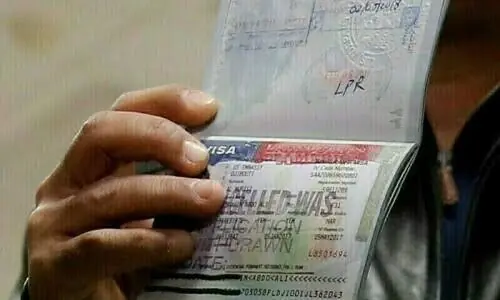
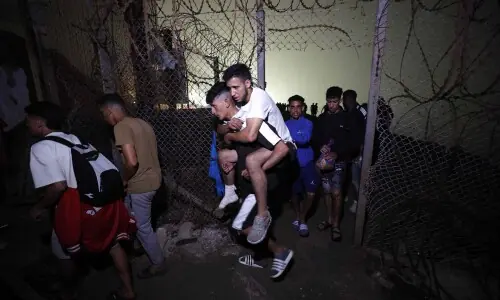
The US honoured a Pakistani officer, Zaheer Ahmed, with the prestigious Trafficking in Persons (TIP) Hero Award for his fight against human trafficking. Given the high score of human trafficking incidence in Pakistan, we need more heroes like Mr Ahmed.
Human trafficking is one of the most lucrative black markets in the world. At $150billion, its size is nearly three times Azerbaijan’s GDP — and this estimation by the International Labour Organisation is nearly a decade old with rate of trafficking rising nearly every year.
Southern Asia is also one of the most affected regions. Pakistan, along with Afghanistan, India, Nepal, Bangladesh and Maldives, has severely pervasive human trafficking markets.
Women and children trapped in containers being transported to be sold for slavery — that is the image the words human trafficking conjure up. But in reality, it exits in almost every industry, including domestic work, agriculture, mining, fishing and commercial sex work. Some forced marriages are also considered human trafficking.
One of its main causes is extreme poverty — defined as living with less than $1.9 a day. The Asian Development Bank estimates that about 2.4pc of employed population lives at less than $2 a day, meaning that at least 1.7m people in the country are at risk to human trafficking.
Bonded labour comes under the definition of human trafficking. The practice of debt bondage in Pakistan is commonly known as Peshgi system. Instead of wages in exchange for their work, poor workers take an advance from an employer, in money or in kind, under the obligation to work for that employer until their debt is paid off.
The loan can be for food to survive though some workers see the bondage as protection against unemployment — the loan ties them to a particular employer who is then perceived to be obligated to continue to provide them with work. The agricultural sector in Sindh that is mostly controlled by landlords, the brick kilns and carpet weaving sector in Punjab, and the coal mines in Balochistan are the main sectors that employ bonded labour.
Global Initiative Against Transnational Organised Crime (GIATOC) estimates that there is medium to high incidence of women being smuggled to Gulf states for sexual exploitation. Human smuggling leading to trafficking however does not embed the victim in the Gulf but tends to be seasonal or occasion specific
There have been media reports of women being lured into marriages and sold into prostitutions. An average bride can earn $25,000 to $65,000 but a paltry amount of something like Rs200,000 is given to the family, according to GIATOC’s report ‘National Initiative Against Organised Crime Pakistan’.
Pakistan does not limit itself to this nefarious exports, it imports as well as acts as a transit destination. There have been reports that educated women (doctors) from Azerbaijan and Uzbekistan are lured in to offers of lucrative jobs in Pakistan, states the GIATOC report. Their documents are confiscated, and they are coerced into prostitution. It is possible that these Central Asian women are smuggled and trafficked further to Gulf and beyond as human cargo.
Published in Dawn, The Business and Finance Weekly, June 19th, 2023