ISLAMABAD: The short-term inflation, based on the Sensitive Price Index (SPI), remained elevated year-on-year at 42.67 per cent for the week ending on June 1, showed the official data released on Friday.
The latest year-on-year inflation reading eased from 45pc recorded in the previous week. It reached an all-time high of 48.35pc for the period ending on May 4.
However, on a week-on-week basis, it posted an slight rise of 0.03pc.
The real impact of the drop in petroleum product prices will be visible in the short-term inflation in next week’s calculations.
The SPI has been on an upward trajectory since Ramazan due to several factors. The depreciation of the rupee, rising petrol prices, an increase in sales tax, and higher electricity bills are among the key contributors to this inflationary trend.
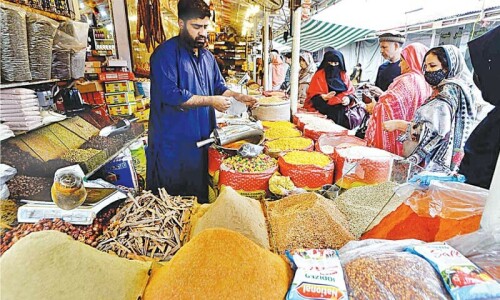
Of the 51 items in the SPI basket, prices of 19 goods soared, 14 dropped and 18 remained unchanged compared to the previous week.
During the week under review, the items whose prices increased the most over the same week a year ago were: cigarettes (138.50pc), tea Lipton (114.93pc), gas charges for Q1 (108.38pc), wheat flour (105.56pc), bananas (88.96pc), potatoes (86.86pc), rice irri-6/9 (80.97pc), rice basmati broken (80.15pc), pulse moong (60.40pc), bread (59.66pc), eggs (55.29pc), pulse mash (53.70pc), washing soap (48.61pc), petrol (45.55pc) and diesel (45.18pc).
On a week-on-week basis, the biggest rise was observed in the prices of onions (7.31pc), potatoes (2.89pc), chicken (2.87pc), tea prepared (1.56pc), tomatoes (1.11pc), salt powdered (1.08pc), rice irri-6/9 & beef (1pc) each and energy saver (2.16pc).
Meanwhile, a decrease was also observed on a week-on-week basis in prices of LPG (4.46pc), wheat flour (4.06pc), bananas (4.04pc), petrol (2.96pc), eggs (2.57pc), diesel (1.94pc), vegetable ghee 1kg (1.87pc), mustard oil (1.57pc), cooking oil 5 litre (1.35pc), pulse moong (1.27pc) and vegetable ghee 2.5 kg (1.06pc).
According to a finance ministry report, the lower-income segment of society is already feeling the brunt of high inflation, which has become unrelenting on the back of political instability, financial mismanagement and delay in an agreement with the IMF.
The government has been taking harsh measures — hikes in fuel and power tariffs, withdrawal of subsidies, market-based exchange rate and higher taxation — under the IMF programme to generate revenue for bridging the fiscal deficit, which may result in slow economic growth and higher inflation in coming months.
Published in Dawn, June 3rd, 2023