0
0

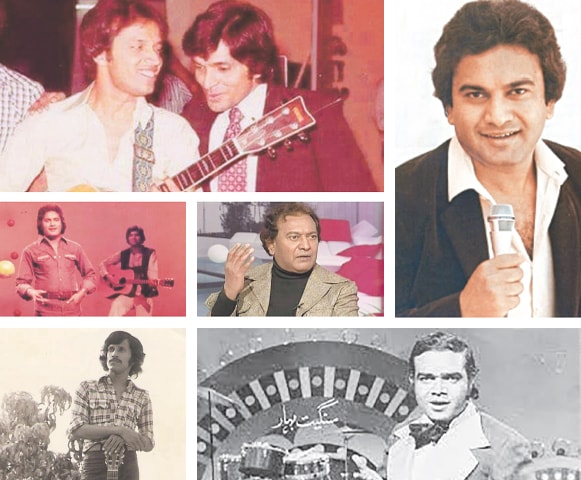
There was a time when any kid’s birthday party was incomplete without Jungle mein mangal tere hi dum se, and same was the case with Main ne tumhari gagar se at weddings.
Karta rahoon ga yaad tujhay main was the perfect song that described the feelings of all lovestruck Romeos while Main tu jala aisa jeevan bhar perfectly defined heartbreak. Moreover, a lone rider had Albela rahi to keep him company while drivers always preferred to sing or listen to Hum chalay tau hamaray to help them eat up the miles briskly.
These hugely popular songs were immortalised by Alamgir and A. Nayyar in a pre-Zia Pakistan. Both these singers flourished despite the imposition of Gen Zia’s martial law and ruled the airwaves for years. However, their meteoric rise was possible not only with lady luck but also Ahmed Rushdi on their side.
No one stays around forever and usually better and younger people take their place. Ahmed Rushdi, the country’s premier playback singer, ruled the roost for well over a decade and was eventually replaced by Alamgir and A. Nayyar in the mid-’70s.
Both Alamgir’s and A. Nayyar’s meteoric rise was intertwined, inadvertently, with the career of Ahmed Rushdi, who they acknowledged as their guru
For upcoming producers and fresh music directors, Rushdi was known for his large heartedness, and many-a-time he had even skipped his fee if he found the producer unable to pay him.
Music was going through a change in the 1970s. Films were being made in colour, although TV transmission was still relayed in black-and-white. Ahmed Rushdi was performing in Bazm-i-Rushdi but watching a 40-year-old twist and turn was unacceptable for a generation that grew up listening to the Beatles, Dean Martin and Frank Sinatra. A young singer was needed whom the youth could easily relate to.
Alamgir, who used to play the guitar in the background of TV shows, rose to the occasion. During an evening with Ahmed Rushdi and Shahnaz Begum at the Karachi Gymkhana, the stars were taking a short break backstage. During the break, Alamgir stepped up and rendered some non-Urdu songs to fill the gap in performance.
The audience swooned on listening to their favourite numbers, and began demanding more from him. Rushdi handed Alamgir the mic and quietly left the event. Alamgir had arrived, but now needed some good songs to survive.
In the year 1974, director Nazrul Islam, music director Robin Ghosh, music composer Karim Shahabuddin, and actors Rehman and Shabnam all preferred to stay back in West Pakistan and serve the film industry. All these legends hailed from East Pakistan and also helped Alamgir move to Lahore.
Fate brought Alamgir to music director Nisar Bazmi who was facing a social boycott for criticising Madam Noor Jehan in an interview. All members of the singers’ association (yes, there was one) were on strike against Bazmi sahib. A song for producer Ali Sufyan Afaqi’s film Jaageer was finalised and needed to be recorded as soon as possible in Ahmed Rushdi’s voice.
Singer Masood Rana, who was leading the association, threatened Afaqi with dire consequences, and refused to let Rushdi record. And just like it happens in films, Alamgir entered the scene and rendered Hum chalay tau hamaray sang sang nazaray chalay.
Afaqi was impressed with Alamgir’s style of singing and okayed it. The association tried to patch things up before the eventual recording but Afaqi refused to budge. Alamgir had arrived and, in the coming years, was the perfect replacement for Ahmed Rushdi.
Later on, sensing alienation in Lahore, Alamgir moved back to Karachi and, with a handful of filmi and non-filmi songs, found a permanent slot on Shoaib Mansoor’s music show Jharnay on PTV.
Alamgir is also known for Dekha na tha, a song composed by Karim Shahabuddin in 1976. Karim Shahabuddin tried to fit in, in Lahore, but failed to find his feet in Lollywood. Like Ghosh, he was a gem of a musician from Bengal and had hits like Jaan-i-tamanna khat hai tumhara and Teri yaad aagayi from the East Pakistan days. Those were the days when Bollywood was hit by Kishore mania, and Pakistanis wanted a piece of that as well.
In 1974, an aspiring singer was heard rendering Soofi Tabassum’s ghazal Naala-i-saba tanha from PTV Lahore. Seated in between empty seats, Arthur Nayyar sounded very much like Kishore Kumar. At the same time, journalist-turned-poet Yunus Humdum was producing a film with his collegemate Nadeem as a lead.
Director Iqbal Akhtar, known for hit films Nadan and Anhoni to his credit, was signed for the project. Humdum had Karim Shahabuddin signed as a music director who had something big in store for the singer Arthur Nayyar. Aware of Iqbal Akhtar’s preference for Rushdi, Humdum and Shahabuddin came up with a plan. They had two songs composed to get the director’s nod. One was a soft number with Rushdi singing Tu saamnay hai meray, and the other was the same song that had made A. Nayyar popular.
Naala-i-saba tanha from Soofi Tabassum became Jee rahay hain hum tanha, where words were changed to fit the depressing filmi situation. A. Nayyar did justice to the song and Iqbal Akhtar was floored after listening to the live rendition. Nayyar’s song was chosen for the mahurat of the film and, after recording this song, he became an all-time favourite of the masses.
A. Nayyar, a disciple of Rushdi, continued to sing in the style of his guru and earn laurels. By the time Humdum’s Sharmeeli was released in 1978, A. Nayyar was a force to reckon with.
On the other hand, a tiff with an upcoming musician became the reason for Rushdi’s permanent return to Karachi. The musician wanted Rushdi to sound like Kishore, and the singer was in no mood to give in.
With the country’s political situation worsening by the late ’70s, the film industry was crumbling. With the increase in Punjabi films, male voices had very little scope for songs. However, A. Nayyar’s determination allowed him to survive the turbulent years and, when he became a senior, he had the services of Tehseen Javed, who was also a disciple of Rushdi.
Alamgir ruled the music scene on TV from 1976-89, until music groups arrived on the scene. Muhammad Ali Shyhaki also came to the fore and the healthy rivalry with Alamgir helped the pop scene bloom. Alamgir even sang Rushdi’s Koko korina at a show in 1991, at the twilight of his career, which introduced many such as this scribe to Ahmed Rushdi, who had died in 1983.
Rushdi was gone, but certainly not forgotten.
Published in Dawn, ICON, May 14th, 2023