0
0
• Sindh, Balochistan lag far behind other provinces, says report
• Malnutrition termed biggest challenge to development • 75pc children in ‘learning poverty’
• Murad shares progress on WB-supported projects in Sindh
KARACHI: Still reeling from the shocks of the Covid-19 pandemic and devastating floods of last year, Pakistan needs to declare emergencies and take bold actions to tackle its health and education challenges, said a World Bank report launched here on Tuesday.
The actions, it says, require long-term planning beyond the tenure of any government and political cycle.
Titled ‘Pakistan Human Capital Review: Building Capabilities Throughout Life’, the report was launched at a local hotel.
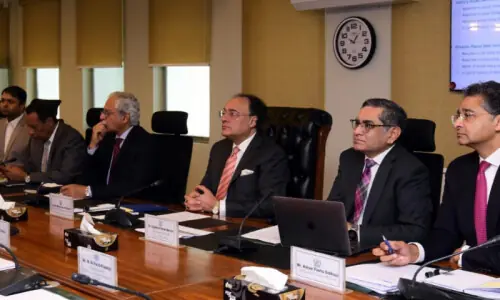
Officials in attendance included Sindh Chief Minister Murad Ali Shah, Health Minister Dr Azra Fazal Pechuho, Chief Secretary Sohail Rajput and senior WB officials, including Special Assistant to the Human Development Vice-President at the World Bank Caroline Vagneron.
According to the report, malnutrition is one of Pakistan’s biggest development challenges, with long-term implications for human capital development and economic growth. It remains the top cause of death and disabilities in the country.
Prior to the Covid-19 pandemic and the 2022 floods, the report points out, an estimated 75 per cent of Pakistani children were in ‘learning poverty’, unable to read and understand a simple age-appropriate story by age 10.
“Imagine the trajectory from birth to adulthood of a child born in Pakistan today. There is a risk that the child may not survive to her fifth birthday. Even if she does reach school age, there is a further risk that she does not start school, let alone complete the full cycle of pre-primary, primary, and secondary education that is the norm in more advanced countries.
“The time she does spend in school may translate unevenly into learning. When she reaches age 18, she carries with her lasting effects of poor nutrition and health in childhood that limit her physical and cognitive abilities as an adult,” the report says.
Poor HC outcomes
The Pakistan’s Human Capital Index (HCI), according to the report, value of 0.41 is low in both absolute and relative terms.
It is lower than the South Asia average of 0.48, with Bangladesh at 0.46 and Nepal at 0.49.
Pakistan’s human capital outcomes are more comparable to those in Sub-Saharan Africa, which has an average HCI value of 0.40.
“Despite favourable demographic tailwinds, Pakistan is currently unable to reap its rightful dividends due to inadequate investments in education, health, social protection, and the labour force.
“Its public investment of about 2.5 per cent of GDP in education and 0.9 per cent on health is much lower than the global average and the average for similar economies. Pakistan spends about 0.6 per cent of GDP on social safety nets, compared with the global average of 1.5 percent.”
The report also highlights the large disparities across socioeconomic and geographic groups. Provincial inequalities, it says, are wide on the HCI and its components, notably for stunting and expected years of schooling.
“In schooling, Khyber Pakhtunkhwa and Punjab are at the expected level for Pakistan’s economic development, with the average child growing up with at least 9 years of formal schooling — though when adjusted for quality, this is equivalent to only 5.1 years.”
Sindh and Balochistan, the report says, are at much lower levels, with the average child growing up with around 7.7 and 5.4 years of schooling, respectively.
“With only 89 per cent of children surviving until their fifth birthday, Balochistan is at the very bottom — globally. The trajectory of child development and human capital accumulation for children born in Balochistan and Sindh is further undermined by the fact that almost half of the children under five in the two provinces are stunted.
“Even in Punjab, where stunting is the lowest among the provinces, one-third of children are stunted.”
Low female labour force participation
According to the report, the strongest driver of low human capital utilisation in Pakistan is low female labour force participation rate — 23 per cent in 2018. Having more than three in every four women outside the labour force underscores the need to make better use of the human capital that Pakistan generates now and in the future.
“If existing trends continue, it (Pakistan) will miss out on the associated economic development possible from a potential demographic dividend in the future as well,” the report says.
During the launch, the chief minister spoke about how the government responded to the challenges of the Covid-19 pandemic and the devastating floods of 2022, which had increased poverty levels from 30 to over 40 per cent in the province.
The chief minister also shared progress of different projects, including the $110m WB-assisted Sindh Water & Agriculture Transformation Project.
Earlier, Vice President for Human Development at WB Mamta Murthi along with her delegation met the chief minister.
Published in Dawn, May 3rd, 2023