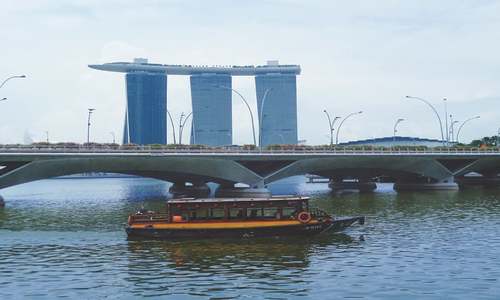
Singapore, a small island located in Southeast Asia, has managed to establish itself as a developed nation with a strong economy in recent years. Despite not having any natural resources, it has transformed itself into an economic powerhouse, serving as a model for other developing countries like Pakistan. What’s the secret sauce behind Singapore’s economic success?
Singapore invested heavily in education and human capital development. The government understood that a skilled and educated workforce is the foundation of any strong economy. The government of Singapore implemented a number of strategies to promote education and skill development.
Education was made accessible for all citizens through the implementation of a national education system. Teacher training and professional development was invested in to ensure that teachers have the necessary skills and knowledge. Science, technology, engineering and mathematics (STEM) education was emphasised on and lifelong learning and upskilling was encouraged.
Singapore created a business-friendly environment that attracted foreign investment, like bees to honey. The government offered tax incentives and streamlined business registration processes, making it easy for companies to set up shops in Singapore.
The small island’s government encourages savings encourage citizens to save more and uses the money to provide for healthcare, housing and education
It transformed itself into an export-oriented economy. The government invested in infrastructure and education to support industries such as textiles and electronics. The country also implemented a comprehensive social protection system that supports its citizens in areas such as healthcare, housing, and education.
The government of Singapore finances the social protection programme through a combination of government funding and contributions from citizens through a mandatory savings scheme called the Central Provident Fund. The government encourages personal responsibility for savings through various measures such as employer contributions and tax incentives to encourage citizens to save more and uses the money to provide for healthcare, housing, and education.
Furthermore, Singapore has a strong system of governance, which has helped it to attract foreign investment, maintain stability and promote economic growth. Additionally, Singapore’s emphasis on unity among various ethnicities and religions played an important role in the country’s development process, promoting social cohesion and integration.
Lastly, the presence of skilled professional politicians was an important non-economic factor that played a major role in developing Singapore. The country’s political leaders, including Lee Kuan Yew and his successors, have played a crucial role in creating and implementing policies that have led to Singapore’s economic success and stability.
Pakistan can learn from Singapore’s experience by investing in education and human capital, encouraging foreign investment, developing a strong export-oriented economy, prioritising social protection, and emphasising on good governance.
As a reader, you may think that Singapore’s success is a result of its small size and unique location, but the truth is that many of the policies and strategies that have worked in Singapore can be adapted to any country. By studying and learning from Singapore’s experience, Pakistan can develop its own effective policies for economic growth and social prosperity.
An action plan
Pakistan has the potential to become an economic powerhouse, not only because of its strategic location, large population and diverse culture but also because of its abundance of natural resources. With the right policies and strategies in place, Pakistan can harness its natural resources to boost its economy and provide universal social protection to its citizens.
Pakistan needs to invest in education and human capital development and increase government funding for education and training programmes. It needs to implement financial assistance programs for citizens to pursue education and invest in teacher training and professional development. Emphasising STEM education prepares students for the future economy.
A business-friendly environment needs to be created by offering tax incentives and simplifying business registration processes. The government needs to encourage public-private partnerships to diversify the economy as well as develop policies and regulations for the exploration and extraction of natural resources in a socially responsible way.
Pakistan needs to develop an export-oriented economy and invest in appropriate infrastructure, trade facilitation and education to support industries such as textiles, minerals and energy resources.
Social protection needs to be prioritised by implementing a comprehensive social protection system that provides support to citizens in areas such as healthcare, housing, and education. Citizens need to be encouraged to save while governance needs to be strengthened to combat corruption.
By taking these actionable steps, Pakistan can boost its economy and provide universal social protection to its citizens by utilising its natural resources just like Singapore.
The writer is a research associate at the Social Protection Resource Centre, Islamabad
Published in Dawn, The Business and Finance Weekly, March 13th, 2023