Restrictions on Afghan women deeply disappointing: Bilawal


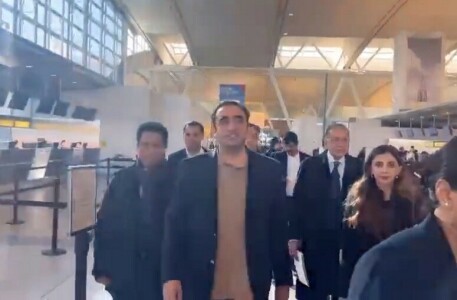
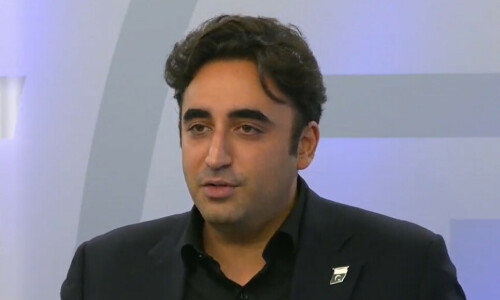
UNITED NATIONS: Afghanistan’s Taliban rulers have deeply disappointed Muslims across the globe by imposing restrictions on women’s right to education and work, Foreign Minister Bilawal Bhutto-Zardari said on Wednesday.
Addressing the first-ever UN-backed conference on ‘women in Islam,’ the foreign minister said that extremists had distorted the image of a religion that encouraged women to actively participate in all walks of life.
“It is but natural for Pakistan — and other OIC countries — to express our deep disappointment at the restrictions imposed on the human rights of women and girls, especially their right to education and work, in Afghanistan,” he said.
“These restrictions are contrary to the injunctions of Islam. I sincerely urge the Afghan interim government to reverse these restrictions and enable the women of Afghanistan to make their full and invaluable contribution to the development and progress of their country.”
Besides representing Pakistan at the conference, the foreign minister was also speaking for all member nations of the Organisation of Islamic Cooperation as the chair of the OIC’s Council of Ministers at the UN. With 57-member states, OIC is the second largest intergovernmental organisation after the United Nations.
Mr Bhutto-Zardari presided over a high-level segment of the one-day conference held at the UN headquarters in New York on the sidelines of the 67th Session of the UN Commission on the Status of Women.
Participants acknowledged that Muslim women still face multiple challenges, stating that the gender development index for OIC countries remains lower at 0.87, less than the global average of 0.94.
FM Bhutto-Zardari, speaking as the OIC council’s chair, said the organisation arranged the conference to “dispel the deep misperception that exists about the rights, roles and identity of women in Islam”.
He said the ‘caricature’ that dominates the perception of Muslim women, particularly in the West, was “based on ignorance of our history, ignorance of our cultural, historical norms and roles that women have played” in Muslim societies.
“The perception of our religion has largely been hijacked after 9/11 by extremists who do not represent our faith and I feel a special responsibility to counter this propaganda and perception,” he said.
“It offends me as a Muslim and Pakistani to the core of my heart that the face of Islam in Western public perception is the likes of Osama bin Laden and not of the likes of Shaheed Benazir Bhutto.”
The foreign minister urged the West to distinguish between Islamic principles and social practices espoused by some patriarchal societies. “This is a distinction that xenophobes, Islamophobes and obscurantists would not like to make — because they believe in discrimination. And discrimination is the first step to tyranny,” he pointed out.

In Islam, he said, a woman “has an independent social and legal identity and enjoys civil, political, economic, and cultural rights. A woman can inherit, divorce, and receive alimony and child custody rights which Islam enshrined before many other religions.”
The Islamic history, he pointed out, has many illustrious women like Hazrat Khadija, Hazrat Ayesha, Hazrat Zainab bint Ali and Hazrat Rabia Basri.
Even today, millions of Muslim women continue to dominate multiple fields — politics, education, health, science, commerce, he said. He also named a few, including the first Muslim female president (of Indonesia), prime minister of Tunisia, prime minister of Turkiye, computer scientist Anousheh Ansari, and Malala Yousufzai, the youngest Nobel laureate.
Pakistani women, he said, had also played an outstanding role in the nation’s history.
“The Quaid-i-Azam’s sister was at the forefront of our independence struggle and in the struggle for democracy.
On March 10, the foreign minister will also chair another high-level event to commemorate the International Day to combat Islamophobia.
Published in Dawn, March 9th, 2023