Afghan women are world’s most repressed: UN mission


 0
0


KABUL: Afghanistan under the Taliban government is the “most repressive country in the world” for women’s rights, with authorities effectively trapping women and girls in their homes, the United Nations said on Wednesday.
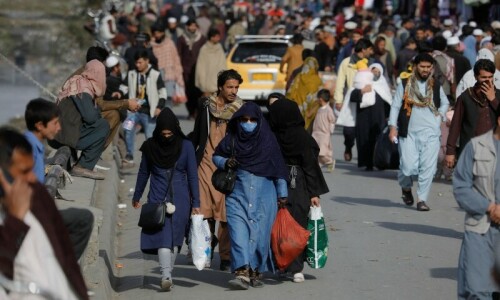
About 20 women held a rare demonstration in a Kabul street on Wednesday, calling on the international community to protect Afghans.
The Taliban government has imposed a slew of restrictions on girls and women since seizing power in Aug 2021.
“It has been distressing to witness their methodical, deliberate, and systematic efforts to push Afghan women and girls out of the public sphere,” Roza Otunbayeva, head of the UN mission in Afghanistan, said in a statement marking International Women’s Day.
The UN mission said the crackdown was a “colossal act of national self-harm” at a time Afghanistan faces some of the world’s largest humanitarian and economic crises.
Taliban authorities have removed women from all but essential government jobs, or are paying them a fraction of their former salary to stay at home.
Women are also barred from going to parks, fairs, gyms, and public baths, and ordered to cover up in public — ideally with a burqa.
But the biggest crackdown has been on teenage girls and university students, with the authorities banning them from secondary schools and higher educational institutions.
Some women have staged sporadic protests against the bans, risking arrest, violence and
social stigma for taking part, but authorities usually disperse them swiftly.
“The time has come for the United Nations to take a decisive and serious decision concerning the fate of the (Afghan) people,” one of the protesters at the Kabul rally read from a statement.
No country has officially recognised the Taliban government as Afghanistan’s legitimate rulers, with the right to education for women a sticking point in negotiations over aid and recognition.
More than half the country’s 38 million people are facing hunger and nearly four million children suffer from malnutrition, aid agencies say.
The crisis was compounded late last year when the Taliban leadership banned Afghan women from working with NGOs, forcing several aid agencies to suspend their vital work.
Foreign aid has also declined dramatically since Afghanistan’s assets were frozen by the United States after the Taliban returned to power, further aggravating the crisis.
Alison Davidian, the United Nations special representative for women in Afghanistan, said the implications of the government’s policies “impact all Afghans and will resonate throughout generations”.
Published in Dawn, March 9th, 2023