0
0

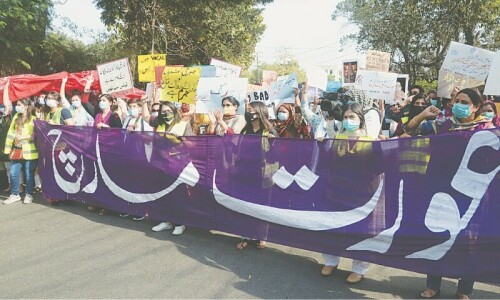
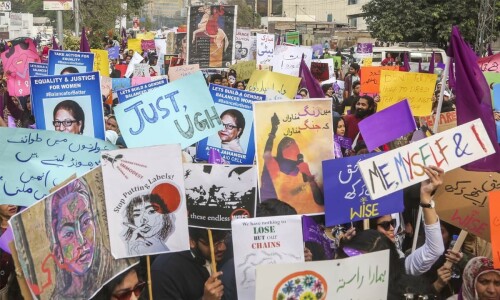
The Islamabad High Court (IHC) on Wednesday dismissed a petition filed by Amun Taraqqi Party (ATP) Chairman Muhammad Faiq Shah challenging the permission granted to organisers to hold Aurat March at F-9 Park.
IHC Chief Justice Aamer Farooq declared the plea non-maintainable after hearing the arguments made by the petitioner’s counsel Nazakat Hussain Abbasi.
Within the plea — filed on March 6 — it had been mentioned that Islamabad Deputy Commissioner (DC) Irfan Nawaz Memon had allowed the National Commission on Status of Women on March 2 to hold the march at F-9 Park on Wednesday (today).
The petition had asked for the DC’s permission to be revoked and that the organisers be directed to not violate the “injunctions of Islam [and] Islamic way of life while holding Aurat March”.
The ATP chief had challenged the permission claiming that the march would “not only spoil the basic family structure of an Islamic state but also promote vulgarity”.
He had further argued that March 8 also coincided with the “Holy day of Shab Barat” (a religious occasion observed by Muslims), implying that the coinciding events could for reasons unexplained not be observed simultaneously.
The petition had said, “To enjoy the protection of law and to be treated in accordance with law, are inalienable rights, available for every citizen of Pakistan.”
The hearing
At the outset of the hearing, Advocate Abbasi said, “According to Article 2 (Islam to be state religion) of the Constitution, the state’s religion is Islam.”
He said the notification of the permission letter given by Lahore District Commissioner Rafia Haider to the Aurat March organisers was an “open violation” of Article 31 (Islamic way of life) of the Constitution.
The petitioner’s counsel further said that Article 16 (freedom of assembly) of the Constitution was “ignored while giving the permission letter”.
Upon hearing this, Justice Farooq said, “Banners and placards are a matter of the past.” “What are you worried about right now?” he asked.
The IHC chief justice further raised the question, “Has freedom of assembly (Article 16) of the Constitution not given them (women) this right (to march)?
Advocate Abbasi responded, “There have been some restrictions imposed in freedom of assembly (article 16). Such a thing is not possible in an Islamic state.”
Upon the completion of the advocate’s argument, the court reserved its verdict and later dismissed the petition.