10 deadliest quakes of the past 100 years

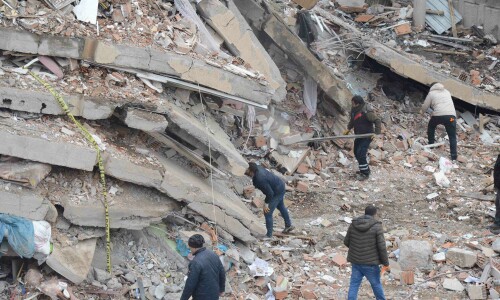
With a death toll standing at more than 50,000, the massive earthquake that struck Turkey and Syria on February 6 and its numerous aftershocks are among the 10 deadliest of the past century.
1976: 242,000 dead, China
A quake measuring 7.8, according to the Chinese authorities, (7.5 according to the US Geological Survey), struck near the industrial city of Tangshan in northeastern Hebei province. The official death toll was given as 242,000 but is believed to be significantly higher.
Western experts put the toll as high as 700,000, which would make it the second deadliest in the history of mankind, after the huge 1556 disaster that struck northern Shaanxi province, with estimates of the toll put at more than 830,000 people.
2004: 230,000 dead, Southeast Asia
On December 26, 2004, a massive 9.1-magnitude earthquake struck off the coast of Sumatra, triggering a tsunami that killed more than 230,000 people throughout the region, including 170,000 in Indonesia alone.
Waves 30 metres high, travelling at 700 kilometres per hour, swallowed everything in their path.
2010: 200,000 dead, Haiti
A magnitude 7 quake on January 12, 2010, devastated the capital Port-au-Prince and the surrounding region.
The quake cut the country off from the rest of the world for 24 hours, killing more than 200,000 people, leaving 1.5 million homeless and shattering much of Haiti’s frail infrastructure.
In October of the same year, Haiti was also hit by a cholera epidemic introduced by Nepalese peacekeepers who arrived after the quake. It killed more than 10,000 people.
1923: 142,000 dead, Japan
On September 1, 1923, two minutes before noon, a 7.9-magnitude quake shook Kanto in Japan. More than 142,000 people died in the earthquake and resulting fire, which destroyed Tokyo.
##1948: 110,000 dead, Turkmenistan
On October 5, 1948, at least 110,000 people were killed in a 7.3-magnitude quake in and around Ashgabat, the capital of Turkmenistan, which at the time was part of the Soviet Union.
2008: 87,000 dead, Sichuan
More than 87,000 people, including thousands of school pupils, were left dead or missing when a 7.9-magnitude quake struck China’s southwestern Sichuan province on May 12, 2008.
The quake caused outrage after it emerged that 7,000 schools were badly damaged, triggering accusations of shoddy construction, corner-cutting, and possible corruption, especially as many other buildings nearby held firm.
2005: 73,000 dead, Kashmir
An earthquake on October 8, 2005, killed more than 73,000 people, most in the former North-West Frontier Province and Azad Jammu and Kashmir. A further 3.5m were displaced.
1932: 70,000 dead, China
On December 25, 1932, a 7.9-magnitude quake killed around 70,000 in Gansu province, in northwest China.
1970: 67,000 dead, Peru
On May 31, 1970, a 7.9-magnitude quake off Peru’s north coast left some 67,000 dead, many in the mountain city of Huaraz that was buried by a mudslide.
2023: more than 50,000 dead, Turkiye and Syria
On February 6, 2023, a 7.8-magnitude quake struck southern Turkiye and neighbouring Syria.
The biggest quake in Turkiye in nearly a century, which was followed by a 7.5-magnitude tremor, killed more than 50,000, according to a toll revised by AFP on the basis of several sources in late February.
Of the dead, more than 45,000 were in Turkey and around 6,000 in Syria.