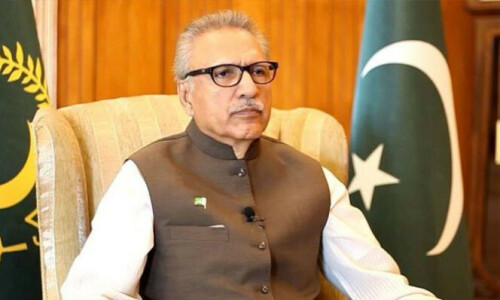
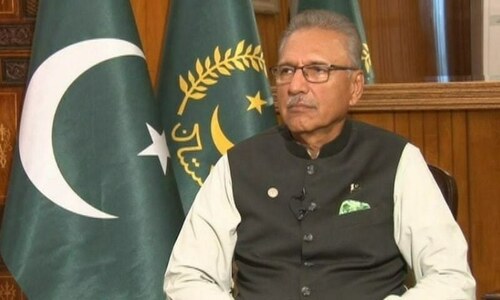
ISLAMABAD: President Arif Alvi on Friday returned the Electricity Generation, Transmission and Distribution (Amendment) Bill, 2022 to the parliament for “reconsideration”, the Presidency said in a statement.
The bill was sent back on the advice of Prime Minister Shehbaz Sharif in accordance with articles 48(1) and 75(1) of the Constitution.
The bill will now be tabled again in the parliament for approval.
The private member’s bill — tabled by PPP’s Qadir Khan Mandokhel — was passed by in the parliament’s joint sitting on Dec 22, 2022.
A private member bill is legislation introduced by lawmakers who are not government ministers.
The bill sought an amendment to Section 18(1) of the Regulation of Generation, Transmission and Distribution of Electric Power Act, 1997.
Alvi was asked by PM to not sign it into law
Outlining the reason for the amendment, the bill stated that electricity distribution companies also disconnect electricity connections of consumers who pay their bills regularly if their neighbours are defaulters.
Calling it an “injustice” to those who regularly pay their bills, the legislation called for a mechanism to end this practice.
Sources in the Presidency said Mr Alvi was advised by the prime minister on Thursday to immediately return the bill.
The action was taken after the power division expressed reservations over the bill, the sources added.
Any bill passed by the parliament is sent by the prime minister to the president who then signs it into law.
This bill had been sitting at the prime minister’s desk for the past three months who had opted not to send it to the president for assent.
When contacted, a constitutional expert belonging to the ruling coalition said the bill was apparently passed despite the government’s opposition. Therefore, the prime minister did not immediately send it to the president for assent.
He said that had the prime minister or the parliamentary affairs ministry sent the bill to the president, he would have been bound to give assent within 14 days as per the Constitution.
The expert claimed the prime minister had not committed an unconstitutional act by holding the bill as the Constitution did not provide any time frame for the transmission of a bill to the Presidency.
He further defended the prime minister’s actions by stating that the contents of the bill suggested that it was “impracticable” for power companies to implement. He, however, agreed that the prime minister should have sent his advice to the president earlier.
Published in Dawn, March 4th, 2023