Chomsky & Afghanistan



NOAM Chomsky the humanitarian activist, political analyst and teacher, founder of modern linguistics, philosopher of the mind and cognitive psychology has been educating the world for almost eight decades. In breadth and depth of knowledge there is almost none to compare with him. Those who do not care to read him are seriously challenged in discussing world affairs. This includes just about every political leader. A thorough familiarity with his writings is almost a precondition for having views relevant to the existential challenges of today. He is an indispensable global asset.
If human civilisation survives the 21st century, it will in no small measure be due to the life work of Chomsky and his legion of students and those directly and indirectly motivated by his ideas and example. The ruling elite of the US wishes to forget him, forgetting he is one of their country’s most valuable gifts to the world. The failure of the Nobel Peace Prize Committee to acknowledge Chomsky is its lasting shame.
Chomsky rejects such accolades. He insists the true heroes of our times are the countless and nameless millions of people whose struggles, organisation and love of humanity provide essential hope for mankind. And yet Arundhati Roy is right in saying “when the sun sets on the American empire, as it will, as it must, Noam Chomsky’s work will survive”. Similarly, Eqbal Ahmad ironically “complained” Chomsky was so “relentlessly right” he left no room for disagreement. Needless to say, Chomsky has his detractors among establishment intellectuals, elites and power brokers all over the world whose carefully manufactured and nurtured narratives crumble in the face of his relentless intellectual onslaughts.
Chomsky has authored more than 150 books and countless seminal articles. His interviews, freely available on the internet, are indispensable listening. At 95 he is frail, but as active, clear minded and committed as ever. When he departs us he will have gone too soon. Of late, he has been collaborating with younger specialists in authoring books on issues which will determine the world we will leave our children and grandchildren. These are books that need to be read, translated and read again; that leaders ignore at the peril of the people they supposedly serve; that can help build an informed public opinion without which pressure for critical social reform for human survival cannot develop; that can keep the Doomsday Clock at bay.
Chomsky does not bother to dress up his message.
Chomsky does not mince his words. He does not qualify his conclusions to please a broader audience. He himself says: “I make outrageous statements purposely if they are true. I don’t care if they are outrageous.” Since few can credibly challenge his statements which are the product of ‘perspiration and inspiration’, as Einstein would say, Chomsky does not bother to dress up his message. He uses irony instead of understatement to drive his point home.
In his latest book, The Withdrawal: Iraq, Libya, Afghanistan, and the Fragility of US Power, co-authored with noted scholar Vijay Prashad, Chomsky makes his usual ‘outrageous’ statements which are true. According to them “US wars against Afghanistan (2001) and Iraq (1991 and 2003) — and today in Ukraine against Russia, and its dangerous confrontation with China — have been with little consideration for world opinion and even less for preventing war through negotiation. The US answers to nobody, not even international law” which it has itself helped draft. This is “the Godfather attitude” which aims to “protect the property, privileges and power of the ruling elite in the US and its closest allies”. It is a continuation of imperialism. Nevertheless, the US had to withdraw from Afghanistan and virtually from Iraq. It has also been unable to control the dynamic in Libya unleashed by its orchestrated assault on Qadhafi.
Let us just consider Afghanistan. According to Chomsky, “the United States went beyond supporting the Mujahideen against the Soviet-installed regime in Kabul. It organised them and collected radical Islamists from around the world. This would have been legitimate if it had been to defend Afghans. But they did not matter. It was to harm the Russians”. [The Mujahideen] “were armed, trained and directed by Pakistani intelligence mainly, but under CIA supervision and control”. Ultimately, many of them ‘morphed’ into Al Qaeda. Eqbal Ahmad warned “the US and its allies were reviving concepts of jihad that had been dormant for centuries in the Islamic world”. Today, educated urban Afghans abhor the Taliban, recall Najibullah with nostalgia, but have no time for Pakistan.
Before the US invasion of Afghanistan, the Taliban “made several tentative offers to extradite bin Laden to Islamic states where the US could have picked him up”. After the invasion the Taliban offered to surrender. Al Qaeda and Osama would have been in US hands. President George W. Bush, however, replied: “We don’t negotiate surrenders. We have bigger aims than that.” The bigger aim, confirmed in 2007 by Gen Wesley Clark, was “the planned aggression into seven Muslim countries in the region: Iran, Iraq, Libya, Lebanon, Somalia, Sudan, and Syria”. Chomsky comments the plan was practically “scripted by bin Laden”. The US did not care. Its attitude was ‘Okay, we have a war against the Muslim world, from Afghanistan to Nigeria to the Philippines’. So what!
Chomsky notes the reactionary anti-feminist Taliban returned to power in August 2021 “partly because of the atrocities of the US occupation and war. They were a Pakhtun organisation in 1994. Now it has roots in all regions of Afghanistan. Yet the US refuses to acknowledge them despite negotiating with them for decades”. As a result, “the Afghan government cannot access its own funds — $9.5 billion in New York banks — when the Afghan people are facing starvation”. Similarly, “the IFIs under US pressure are withholding Afghan funds from Afghan relief as US victims of 9/11 demand reparations” at the expense of the Afghan people who had nothing to do with it. US courts find against the Afghan people. (However, on Tuesday, a US court ruled that families of the victims of 9/11 could not claim $3.5 billion belonging to Afghanistan’s central bank. The Afghan people, it said, should not have to “pay for the Taliban’s liability”).
Chomsky makes clear the world has a choice: submit to the US imperial order or choose survival in accordance with the UN Charter.
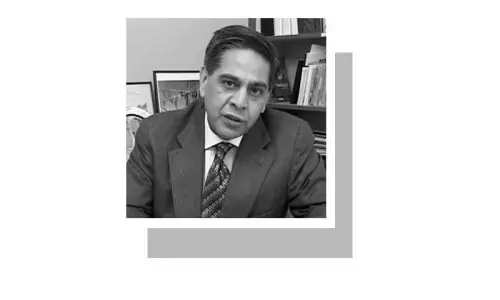
The writer is a former ambassador to the US, India and China and head of UN missions in Iraq and Sudan.
Published in Dawn, February 24th, 2023