0
0

DESPITE a mild weekend profit-selling of overvalued oil shares, the stocks maintained their bull-run last week as investors continued to build up long positions at the inflated levels. There was a general perception that a technical correction was overdue now but the weekend selling was too feeble to check the market’s bullish trend. It needed further correction on which a fresh strong rally could be built beyond the index level of 10,000 points.
The renewed massive covering purchases aided by the market talk of higher dividend gave a pleasant surprise to many analysts as massive gains in the National and Muslim Commercial banks were said to be beyond their annual earnings. However, both were inching towards their career best levels although the former was well-ahead of the latter.
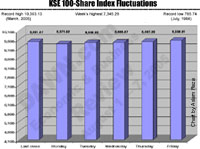
The KSE 100-share index last week virtually galloped to its New Year target of 10,000 points as the leading bulls were not inclined to take a technical breather after having crossed the Rubicon for the second time in about a year. The index finished with a net rise of 329.69 points at 9,886.30, adding Rs90 billion to the market capital.
The shares of bank, cement, auto, insurance, oil and other blue chips, including the PTCL came in for strong covering purchases and finished with smart gains, supporting the sustained run-up of the index.
In the New Year trading, the talk of the index level at 10,000 did not appear too ambitious, said an analyst, adding that the talk beyond it now seemed more relevant.
Some others predicted that the index could move either-way within 8,000 on the lower side and 12,000 on the higher side if all goes well with the external background news.
Click to view the larger image
Tensions over the Kalabagh dam and developing situation in Balochistan could take their toll during the year but on technical grounds higher corporate earnings and economic growth could push the market further up, they said.
But the market’s sustained run-up reflected that the market had already absorbed the negative fallout of the irritant and seemed to follow its own dictates rather than the bad news, they added.
Although, most of the leading shares in banking, cement and oil sectors had already touched their saturation points owing to a persistent run-up, the investors were not inclined to take profits followed by reports that the best was yet to come.
The stocks, therefore, opened the New Year account on a bullish note amid heavy buying in active shares aided partly by the perception of improved performance for the fifth year in a row, and on account of positive economic indicators.
The KSE 100-share index rose by at 9,886.30 points, the week’s high as compared to 9,556.61 at the last weekend as leading base shares put on fresh smart gains under the lead of the PTCL, the NBP and the MCB followed by leading cement shares.
The robust New Year opening reflected that the investors had ignored the tussle between the SECP and the KSE over non-member chairman of the bourse and was essentially guided by the broader market reform and the strength of an ambitious privatization programme of the state-owned units.
The credit for a positive New Year opening was largely shared by the bank, cement and oil sectors which initiated buying after making fresh covering purchases at highly inflated levels.
The index seemed to have begun its march to its previous all-time peak level of 10,300 or beyond on the strength of sell-off of leading state-owned oil units, positive economic growth, and higher corporate earnings, analysts predicted.
No one was clear about the negative fallout of the Kalabagh dam issue and the developing situation in Balochistan.
None could, however, rule out the possibility of technical corrections after each rise but the New Year outlook appeared a bit bullish despite the presence of some immediate market depressants, brokers said.
A series of reform to restore the transparency in stock trading initiated by the SECP over the last couple of years, notably during the 2005, were in the final analysis and will go a long way in netting new clientale having massive amounts of idle money with them, some others said.
The PTCL led the New Year fine rally as fears of the Etisalat deal were allayed, signalling that the worst was over and there were reasons to believe that it could build a strong forward base around these levels.
Plus signs dominated the list under the lead of Dawood Hercules, Attock Petroleum, Gillette Pakistan, Unilever Pakistan, Shell Pakistan, Colgate Pakistan, the AKD Securities, Millat Tractors, Suzuki Motors, Indus Motors, Glaxo-SKF, Thal Corporation, Nestle Pakistan, Rafhan Maize Products, and others.
Losers were led by the Shezan International, Artistic Denim, Quetta Textiles, Unilever Pakistan, Mitchlles Fruits, the EFU General, Lakson Tobacco and others.
FORWARD COUNTER: Speculative issues on the forward counter also finished with fresh gains under the lead of National Bank, the MCB, Engro Chemicals, Lucky Cement, the PTCL, Fauji Fertiliser, Bin Qasim and others on active short-covering at lower levels. Others rose modestly amid light trading.
—Muhammad Aslam