SC overturns verdicts in favour of khula


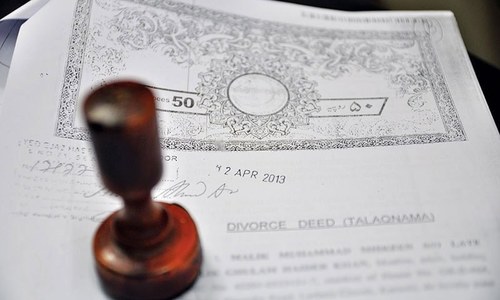
ISLAMABAD: In a family suit, the Supreme Court on Wednesday set aside the Peshawar High Court (PHC) and appellate court decisions for dissolution of a marriage by way of khula and restored the decree of a family court to dissolve the marriage on the basis of cruelty inflicted by a man on his wife.
While the family court after recording of evidence and hearing both sides had dissolved the marriage due to cruelty on a suit moved by Tayyeba Ambareen against her husband Shafqat Ali Kiyani demanding dower amount, dowry articles, medical expenses and maintenance for herself and their daughter, the appellate court on Nov 10, 2015 overturned the decree and converted it into khula with the direction to the woman to refund five-tola gold to her husband. The high court also upheld the appellate court decision.
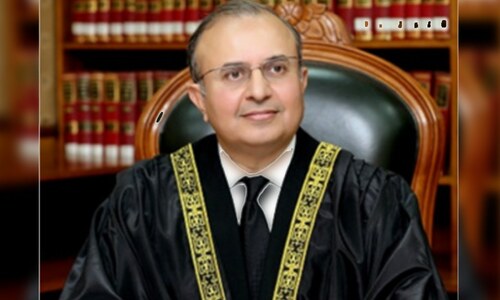
Headed by Justice Sardar Tariq Masood, a three-judge Supreme Court bench then took up an appeal against the PHC verdict.
In its decision, the apex court observed that husband’s claim of conjugal rights — despite his ‘ruthless, tyrannical and oppressive’ conduct or behaviour — seemed to be motivated by the sole intention to avoid paying maintenance allowance and the dower amount and he ultimately succeeded in his effort when the appellate court dissolved the marriage by way of khula with the direction to the wife to refund the dower amount.
Husband’s claim of conjugal rights seemed to be motivated by his intention to avoid payment of dower amount, judge observes
Justice Mohammad Ali Mazhar, a member of the SC bench, in a judgment he wrote, observed the main disagreement or source of discord between the parties was whether petitioner Tayyeba Ambareen was entitled to claim a decree for dissolution of marriage on the ground of cruelty and whether the appellate forum rightly converted the dissolution of marriage on the ground of cruelty to dissolution by way of khula.
The SC noted that the family court unequivocally articulated that the petitioner discharged the burden of proving cruelty on part of the husband by quoting many incidents while her evidence was not shattered during her cross-examination and thus the family court rightly dissolved the marriage on account of cruelty after a thorough examination and consideration of evidence.
Justice Mazhar observed that the appellate court could modify or set aside the judgment of the family court if it was found contrary to the evidence since the purpose of appellate jurisdiction was to reappraise whether the lower court committed any error. Likewise, he noted, the high court affirmed the findings of the appellate court without realizing that the allegations of maltreatment and cruelty had been satisfactorily proved by the petitioner during the trial.
The matrimonial bond between a man and woman is a pious relationship that plays an important part and also nurtures between the husband and wife happiness and compassion, the lineage and family heredity also depends on it, Justice Mazhar observed, adding the connubial affairs are based on gentle, human and emotional affiliation which requires mutual trust, regard, respect, love and affection and the relationship should also be in accordance with social norms.
As Islam ordains husbands to provide food, clothing, accommodation and all other necessities of life to the best of his capability and capacity, a man is expected to treat his wife nicely, with love and affection, Justice Mazhar observed. A conduct or behaviour that inflicts upon the wife mental pain and anguish makes it impossible for her to continue matrimonial relationship, the verdict explained.
Justice Mazhar recalled how the family court decision depicted different acts which caused mental anguish and torture to the wife, as only a week after their marriage, the husband started pressurising his wife to arrange money to get a house on rent. The husband and his family members also levelled false accusations at her, alleging that his daughter was not their child, with the result that the petitioner suffered severe mental agony, the court noted.
While she was in the family way, the man left her instead of supporting his wife, the court observed. He did not turn up at the crucial time; neither did he pay any maintenance allowance nor delivery expenses, it was recalled.
Also, the husband and his family members imposed a harsh condition on her that she should deposit her salary into a joint account with her husband and seek his permission for personal use.
Despite filing the family suit, the husband’s behaviour did not change rather he caused more mental anguish and started levelling false accusations, imposing condition that the amount for the house purchased by the wife be reimbursed by her father to the husband.
But the apex court noted that the appellate court, instead of considering the evidence reached a conclusion without any reason that no solid piece of evidence was brought to show physical torture or mental agony and held the allegation was exaggerated, adding that the “acts of cruelty were common” in nature and were “found in every family”.
On the basis of the observations, the Supreme Court set aside the judgments of the high court and the appellate court and restored the decree passed by the family court.
Published in Dawn, December 22nd, 2022