0
0

 AFTER a hectic and energy draining week, the Hong Kong phase of the Doha Round of Multilateral Trade Negotiations (MTNs) limped forward as 149 trading nations of the world signed a deal that in the apt words of the Foreign Minister of Brazil, Celso Amorim, is “modest but not insignificant.” Agreement was reached on some of the relatively modest items on the table.
Before even the commencement of the round there was a marked recalibration in expectations from the talks. Several deadlines had been already missed and the MTNs went virtually into a state of suspended animation in the fifth ministerial conference held at Cancun.
However, resurrection took place after a framework agreement (also known as the July Package) was reached on August 01, 2004 at Geneva. In Hong Kong very few people arrived with expectations for a breakthrough because there was no agreement in sight. It was really most unrealistic to expect a breakthrough occurring at the Hong Kong ministerial conference.
The most important achievement of the Hong Kong conference was avoiding the breakdown of negotiations and preserving the momentum of talks. A failure to do so would have been disastrous for the multilateral trading system and in particular for developing countries.
Now, it is anticipated that the talks would conclude in the next year. However, it is very possible that there will be no successful conclusion even in 2006. Given the pattern of MTNs, to miss deadlines would not be a catastrophe, provided the process of dialogue continues.
Eight rounds of MTNs were held under the auspices of the General Agreement on Tariffs and Trade, including the Uruguay Round, which led to the establishment of the World Trade Organization (WTO) in 1995.
MTNs are becoming more and more complex with the passage of time due, among other things, to a marked increase in the number of players and a bewildering variety of conflicting interests. From 23 countries, which were parties to GATT in 1947, the WTO’s membership has increased to 149 in 2005. The Uruguay Round took about eight years to complete and on the way there were many setbacks. The current MTN — the Doha Development Agenda — is the first to be conducted under the auspices of the WTO. Jagdish Bhagwati, the eminent economist, has appropriately described this round to be “a roller coaster, full of near breakthroughs followed by near breakdowns.” The same pattern persisted in the recently concluded meeting in Hong Kong.
By and large, there was a sense of some achievement. “Despite the long hours and hard work, it was worth it, we have managed to put the round back on track after a period of hibernation.” This is how WTO Director-General Pascal Lamy described the Hong Kong Ministerial Declaration.
However, NGOs expressed profound disappointment on the outcome. Walter Bello, the Philippines’ economist, one of the most articulate voices of the NGO movement, described the declaration as “a recipe for disaster, and many developing countries will not be able to convince people back home that they have come back with a good deal.” This opinion, however, is in the view of this writer incorrect and does not take into account the reality on the ground.
The Hong Kong Ministerial Declaration, inter alia:
i) Affirmed commitment to the mandate on agriculture as set out in the Doha Ministerial Declaration and the July Package, and provided that there will be three bands for reductions in final bound total AMS with higher linear cuts in higher bands.
ii) Allowed flexibility to developing countries to designate the appropriate number of tariff lines as special products. They will also have the right to a special safeguard mechanism.
iii) Resolved to establish modalities (on agriculture) no later than April 30, 2006 and submit draft schedules in this regard no later than July 31, 2006.
iv) Resolved that all forms of export subsidies for cotton will be eliminated by developed countries in 2006.
v) Provided that trade distorting domestic subsidies for cotton production should be reduced more ambitiously then under whatever general formula is agreed.
vi) Non-Agriculture Market Access (NAMA): Adopted a Swiss formula with coefficients at levels which shall, inter alia; reduce, or as appropriate eliminate tariffs, including the reduction or elimination of tariff peaks, high tariffs and tariff escalation, in particular on products of export interest to developing countries, and take fully into account the special needs and interests of developing countries, including through less than full reciprocity in reduction commitments.
vii) Acknowledged the principle of balance between NAMA and agriculture and stated that the development objectives of the round can be advanced through enhanced market access for developing countries in both agriculture and NAMA.
viii) Resolved that the negotiations on trade in services shall proceed to their conclusion with a view to promoting the economic growth of all trading partners and the development of developing and least-developed countries and with due respect for the right of members to regulate.
ix) Provided that aid for trade should aim to help developing countries, particularly LDCs, to build the supply-side capacity and trade-related infrastructure that they need to assist them to implement and benefit from WTO agreements and more broadly to expand their trade.
x) Duty-free market access: provided that developed country members shall, (and developing country members, declaring themselves in a position to do so) provide duty-free and quota-free market access on a lasting basis, for all products originating from all LDCs by 2008 or no later than the start of the implementation period in a manner that ensures stability, security and predictability. Members facing difficulties at this time to provide market access as set out above shall provide duty-free and quota-free market access for at least 97 per cent of products originating from LDCs, defined at the tariff line level, by 2008.
Hong Kong’s Commerce, Industry and Technology Secretary John Tsang, the Chairperson of the Conference, outlined the achievements of the conference in the following words:
*We have secured an end date for all export subsidies in agriculture, even if it is not in a form to everybody’s liking.
*We have an agreement on cotton.
*We have a very solid duty-free, quota-free access for the 32 least-developed country members.
*In agriculture and NAMA we have fleshed out a significant framework for full modalities.
*And in services, we now have an agreed text that points positively to the way forward.
Industrialized countries thus made a commitment to phase out subsidies on farm exports by 2013 and also came up with a somewhat watered-down package of special trade deals and new cash to help the world’s 32 poorest nations (least-developed countries).
The US and Europe also promised to move aggressively to help African cotton growers. Hard decisions on agriculture, industrial goods and services were, however, deferred to the next year with an agreed deadline of April 30 to fill in many significant blanks left in the Hong Kong Declaration.
Both according to developing and industrialized countries several crucial issues remain unresolved, such as NAMA. “Market access is the central component going forward to measure the round’s success,” Deputy United States Trade Representative Susan Schwab observed.
Likewise for developing countries, it was extremely unsatisfactory that there was no agreement on a date to end domestic farm subsidies, but it is some consolation that export supports would be eliminated by 2013.
In many respects the Hong Kong Declaration is a significant step forward as compared to the draft declaration proposed before the conference. A number of issues have been settled or partly settled.
The declaration, no doubt, has not succeeded in addressing many important concerns of developing countries, but looking with the attitude of seeing the “glass half full,” it should be a matter of gratification that an end date has now been fixed for elimination of agricultural export subsidies.
The end date obviously does not indicate that these subsidies will be only removed by 2013. The process is expected to begin much earlier and it would be even possible to see an end of subsidies by 2010.
All the three major groups of countries did far less than they should have. According to an insightful analysis: The European Union’s Trade Commissioner, Peter Mandelson, assumed an attacking posture from the outset in an effort to steer the discussion away from opening up Europe’s subsidy-soaked agricultural sector. The US, while taking the high ground, without any embarrassment tried to cut side deals with smaller nations to quiet its narrow-minded industry lobbyists back home. And the developing countries banded together to try to water down agreements on expanding trade in services.
Much was not achieved in the field of “services.” A less ambitious draft text agreement was adopted then had been hoped for earlier. This area, which Ms Schwab described as “a new area in many ways for negotiations” proved particularly difficult. In the final heads of delegation meeting before the conference’s close, a handful of countries threatened to derail even the present somewhat modest services text and thereby jeopardize the outcome of the conference itself.
The progress on a development package for the WTO’s poorest members was also less than expected. Industrialized countries agreed to grant the world’s poorest nations largely unfettered quota-free and duty-free access to their markets.
At least 97 per cent of their exports will qualify for this preferential treatment by 2008. That was less than the 99.9 per cent they had originally asked for, but better than an original offer of 95 per cent. The US, in particular, is afraid of a deluge of textile and clothing exports from Bangladesh and Cambodia.
As to cotton, which proved an important disruptive factor at Cancun, the West African countries had hoped for a fixed date for elimination of US cotton subsidies along with a comprehensive package of financial and technical assistance.
While the US agreed that it would end export subsidies for the industry with effect from next year, it would not agree to a timetable for ending domestic supports linked to production.
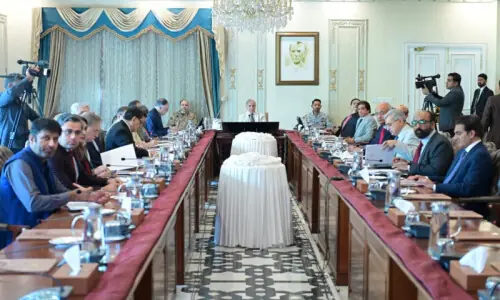
Mr Humayun Akhtar Khan, Commerce Minister of Pakistan, made a valuable contribution to the agreement reached in the conference. The Pakistani delegation particularly deserves praise for safeguarding the interest of Pakistan, which was threatened due to the unintended consequences of duty-free market access for LDCs.—The writer is adjunct professor of international trade (WTO)law, Punjab University Law College, Lahore. Views expressed are his own).