• Fresh ECP count raises questions about polls held on previous lists
• Today’s by-elections to be held on old rolls
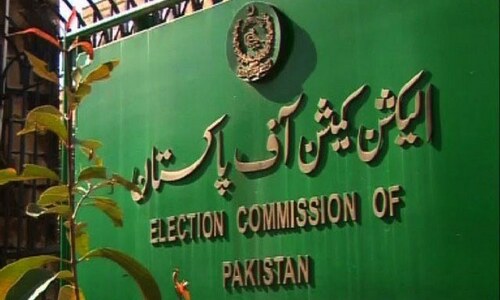
ISLAMABAD: Despite the registration of new voters in an exhaustive nationwide exercise carried out by the Election Commission of Pakistan (ECP), the number has dropped by no less than 2.55 million voters over the last five months. The reason: the ECP worked extra mile and found names of the dead and eventually deleted them from the rolls.
But this negligence has raised questions over the credibility of electoral rolls that were used to conduct several elections in the past.
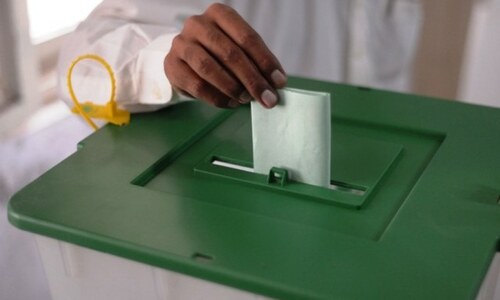
An ECP official, when contacted, told Dawn that by-polls in eight national and three provincial assembly constituencies taking place on Sunday (today) would be held on the old voters’ lists. The new electoral rolls would be used in subsequent electoral exercises, the official added.
The total number of voters in May was 124.75m which has now slipped down to 122.19m, an analysis of the latest data and the one released in May reveals.
While the number of male voters dropped from 68.02m to 66.40m, that of female voters decreased from 56.72m to 55.78m.
On the positive side, the gender gap between male and female voters went down from 11.30m in May to 10.61m now.
Of the 2.55m deleted names, Punjab accounts for 1.46m, followed by Sindh (0.563m), Khyber Pakhtunkhwa (0.495m) and Balochistan (78,063).
Islamabad is the only region where the number of voters increased from 0.938m to 0.984m.
Punjab alone accounts for the gap of 5.49m voters between men and women — exceeding the gap in all the other provinces put together. The gender gap in Sindh and KP comes to 2.35m and 2.05m, respectively. In Balochistan, it stands at 0.665m.
An analysis of the district-wise rolls, a copy of which is available with Dawn, shows that the number of districts having a gender gap of over 200,000 has come down from 16 in November 2021 to seven — all of which are in Punjab.
The districts out of the list of a gap of over 200,000 include Bahawalnagar, Muzaffargarh, Multan, Vehari, Okara, Bahawalpur, Sargodha and Khanewal (Punjab) and Karachi (West).
In Lahore district, the total number of registered voters stands at 6.43m, which includes 3.45m male and 2.97m female voters, translating into a gap of 0.480m. Last November, this gap was as high as 0.548m.
In Faisalabad, the gap has dropped to 0.412m from 0.448m last year. The total number of voters enrolled in the district is 5.03m, including 2.72m men and 2.31m women.
Gujranwala is next in line having a gender gap of 0.327m. The gap was 0.354m in November. The total number of voters in the district stands at 3.24m, including 1.78m males and 1.45m females.
In Rahim Yar Khan, the gap has gone down from 0.351m last year to 0.278m. The 2.88m voters in the district include 1.58m men and 1.30m women.
In Kasur district, the total number of voters has reduced from 2.17m in November last year to 0.213m now. They include 1.18m males and 0.947m females, showing a gap of 0.240m.
In Sheikhupura, the gap has come down from 0.254m in November 2021 to 0.240. The 2.13m registered voters include 1.18m males and 0.947m females.
Sialkot has 2.64m registered voters, of which 1.43m are males and 1.20m females. The gap comes to 0.226m.
In Muzaffargarh, the gender gap was 0.233m last year which has now slipped down to 0.182m. The total number of voters stands at 2.42m, including 1.30m males and 1.12m females.
Gender gap among voters in Bahawalnagar has come down from 0.229m last year to 0.195m. The total number of voters is 1.77m which includes 0.985m male and 0.790m female voters.
The gap among voters in Multan is 0.183m, Vehari (0.182m), Okara (0.180m), Bahawalpur (0.178m), Sargodha (0.176m) and Khanewal (0.157m).
In contrast, women form over 48pc of the total registered voters in five districts, including four in Punjab and one in Balochistan.
Chakwal district in Punjab has the unique distinction of having more than 49pc female voters of the total, making it a role model. The total number of registered voters in the district has slipped to from 1.19m last year to 1.16m. It includes 0.594m (50.84pc) males and 0.574m (49.16pc) females. That translates into a minor variation of 19,584 among well over a million voters.
In Jhelum district, the number of voters stands at 1.01m, including 0.524m (51.65pc) males and 0.491m (48.35pc) females.
In Rawalpindi district, the proportion of women voters is 48.20pc, in Sohbatpur (Balochistan) 48.17pc and in Attock it is 48.02pc. Other districts with high proportion of female voters include Khushab (47.83pc), Islamabad (47.36pc and Washuk (47.09pc).
Published in Dawn, October 16th, 2022