THE monumental scale of the catastrophe staring this country in the face has been evident for some time. Pakistan cannot hope to rebuild and rehabilitate what the ‘monster monsoon’ has destroyed unless the international community steps in with generous aid.
Precise figures will have to wait until a comprehensive survey is completed, but initial estimates hover around $30bn. According to the revised ‘Pakistan Floods Response Plan 2022’, which is to be launched in Geneva on Tuesday, between $600m and $800m is needed for immediate and urgent needs.
Read: After the deluge
Another recent survey has found that over half of 33m people impacted by the floods in one way or another are sleeping out in the open, in tents or in flimsy makeshift shelters; a majority do not have access to toilets and have to relieve themselves near the stagnant water, a disastrous situation ripe for the spread of diseases like cholera and dysentery.
If things do not improve drastically by the time winter sets in, the health emergency will take on even more nightmarish proportions.
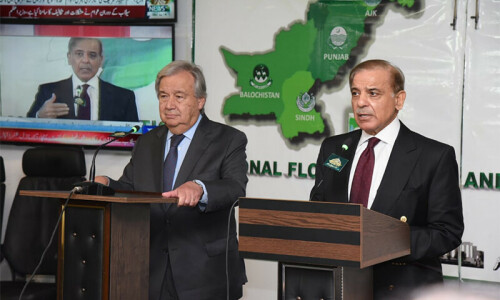
UN Secretary General António Guterres has made impassioned appeals for the world to step and help Pakistan. Prime Minister Shehbaz Sharif and several cabinet members have also repeatedly called for the international community to comprehend the magnitude of the challenge and extend a hand. Sadly, the world’s response has been somewhat lukewarm.
Already, the lack of funds for tackling the immediate requirements of the suffering millions is eroding Pakistan’s long-term defences against the ravages of climate change.
Talking to reporters last week, Minister for Climate Change Sherry Rehman said the government has diverted “all development and climate-resilience funds towards relief… .” She also spoke of the impending food insecurity, referring to the dire warnings by FAO and WFP in the Hunger Hotspot Report 2022. As per its forecast, she said, more than 26pc of the population in Sindh, Balochistan and KP would experience severe food insecurity — not surprising, given that over 4m acres of agricultural land in total, including swathes of standing crop, were affected by the floods.
Read: PPP govt has turned disaster into new source of money making, says Arbab
In this situation, it is abhorrent that some opposition figures, most recently former Sindh chief minister Arbab Rahim, are using the catastrophic floods for political point-scoring in callous disregard of the possibility that their words could discourage international aid for relief and rehabilitation efforts. If there is any time for the civilian leadership to show unity, it is now.
Published in Dawn, October 3rd, 2022