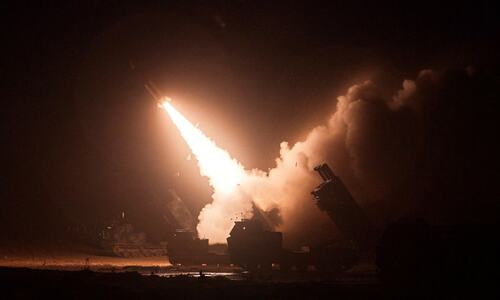
US, Japan, South Korea hold anti-submarine drills
Published October 1, 2022
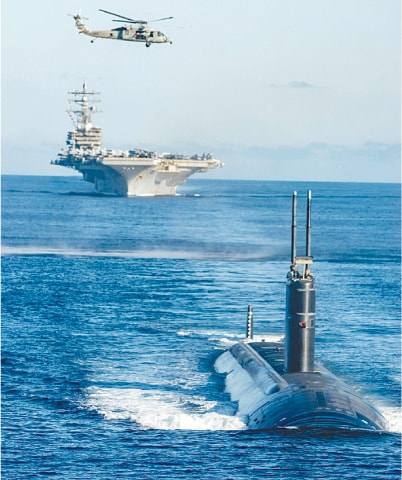
A HANDOUT photo released by South Korea’s defence ministry shows the US Navy’s nuclear-powered USS Annapolis submarine (bottom) and the nuclear-powered USS Ronald Reagan aircraft carrier (centre) during a trilateral anti-submarine exercise held by South Korea, the United States and Japan in international waters off the Korean peninsula.—AFP

SEOUL: The navies of South Korea, the United States and Japan staged trilateral anti-submarine exercises for the first time in five years on Thursday, amid tension over North Korea’s series of missile tests.

The drills were held in international waters off the Korean peninsula’s east coast, just a day after North Korea fired two ballistic missiles into the sea off its east coast and US Vice President Kamala Harris visited Seoul and the heavily fortified border between the two Koreas.

Thursday’s test was the third such launch in five days by the North, which has fired an unprecedented number of missiles this year.

“The exercises are designed to improve their capability to respond to increasing North Korean submarine threats, including its submarine-launched ballistic missiles (SLBM) at a time when it consistently poses nuclear and missile threats with a series of ballistic missile tests,” the South Korean navy said in a statement.

The US navy said the drills will enhance inter-operability and tactical and technical coordination between the three countries.

The US and Japanese navies also said the exercises are expected to promote “a free and open Indo-Pacific”, amid tension over China’s actions in the Taiwan Strait.

The anti-submarine drills have not been conducted since 2017 because the former progressive South Korean government sought to improve relations with the North and facilitate denuclearisation talks between Pyongyang and Washington, which have stalled since 2019.

South Korea’s new President Yoon Suk-yeol, who took office in May, has vowed to boost trilateral security cooperation with the United States and Japan to better counter the North’s evolving weapons threats.

Published in Dawn, October 1st, 2022

Opinion

Respite needed

Respite needed

All one can fear is a familiar accounting exercise that aims to extract a few more rupees from a narrow, weary economic base.

Editorial

Soft on traders
08 Jun, 2026

Soft on traders

THE Fixed Tax Asaan Scheme for traders with an annual turnover of up to Rs200m has been designed as a ‘pragmatic...
Ceasefire in name
08 Jun, 2026

Ceasefire in name

THE latest exchange of fire between the US and Iran raises the question: at what point does a ceasefire cease to be...
Damaged childhoods
08 Jun, 2026

Damaged childhoods

CHILD abuse is so prevalent that the UN ranked Pakistan as the least safe country for children. Even so, more than...
JAAC ban
Updated 07 Jun, 2026

JAAC ban

Though the JAAC’s demands are open to scrutiny, banning any political organisation — as long as it remains committed to peaceful activism — is undemocratic.
GB election
Updated 07 Jun, 2026

GB election

It is important that whichever party ultimately forms the government puts the needs of the people of GB above everything else.
ODI win
07 Jun, 2026

ODI win

AT last, the Pakistan cricket team had something to celebrate: a One-day International series victory against...