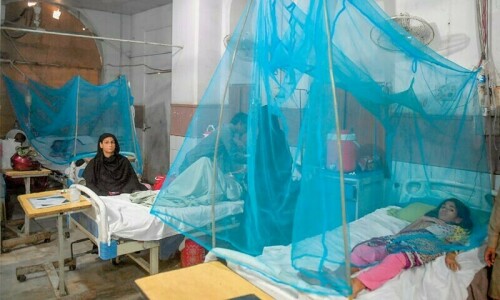
Dengue fever cases continue to register increase in KP


 0
0


PESHAWAR: The shortage of female health workers, lack of public awareness and faulty coordination among line departments have been hampering the efforts to prevent outbreak of dengue fever as the mosquito-borne ailment caused by the recent floods continues to surge in the province.
Health experts have attributed risk of water-borne ailment in displaced population to shortage of female staff in newly merged districts for door-to-door activities and lack of ownership of the anti-dengue efforts by people for their own safety.
Health officials in the newly-merged districts told Dawn that shortage of female health workers was affecting the campaign to check houses for larva and scale up awareness level of women about storage of water in uncovered pots, main source of mosquito’s production.
They said that lack of coordination among 19 line departments to a desired level to ensure prevention of dengue outbreaks was among the prime reason for fear of rise in cases of the disease in aftermath of floods.
Shortage of female staff and lack of coordination among depts hamper efforts against the disease
Khyber Pakhtunkhwa is known for outbreaks of mosquito-borne disease due to unsanitary conditions and haphazard urbanisation. The cases of ailment continue to surge because of favourable environment for breeding of mosquitoes.
Officials said that the province recorded 24,938 dengue cases and 70 deaths in 2017, with 0.28 per cent case fatality rate. Peshawar remained the epicentre of the epidemic by registering 94.3 per cent patients.
The infection again broke out in 2019, infecting 7,083 people with no death. Last year, the mosquito-borne disease was detected among 10,617 patients and 10 of them died.
As of September 14, virus affected 3,520 people with seven districts including Charsadda, Lower Dir, Haripur, Khyber, Mardan, Nowshera and Peshawar recording more than 100 positive cases each, according to a report of health department regarding dengue fever. “Of the total infected persons, 2,775 patients have recovered,” it said.
During the last 24 hours, the province confirmed 310 new cases and 30 admissions, raising the tally of hospitalisations to 483. There are 741 active cases. Currently, 85 dengue patients are being treated in hospitals.
Physicians at the hospitals said that only health department was regarded to be responsible for prevention of dengue fever but it was also the job of other departments to eliminate mosquitoes and breeding sites by spraying and ensuring uninterrupted supply of electricity so that people did not resort to storing water unnecessarily and get protection against bites.
Chief Secretary Dr Shahzad Khan Bangash has tasked all departments for time-bound activities as part of Dengue Action Plan 2022 under which district dengue response units have been established at the district level for collaboration of departments under the respective deputy commissioners.
Guidelines have been circulated to all departments as per plan, which seeks to make available trained staff and equipment for vector detection, spraying and enforce case management control strategies.
Officials said that health department deployed 36 medical entomologists for vector surveillance and response in high-risk districts. They said that 18 union councils were declared high-risk, 25 medium and 175 low risk where regular surveillance was started through scientific collection of information on dengue vector habitat and breeding spots.
So far larva in 13,533 houses of total 8,194,866 inspected by health workers had been destroyed.
Officials said that they also checked more than two million containers and found larva in 18,775 in addition to spraying larvicide on 7,508 breeding sites.
Published in Dawn, September 15th, 2022