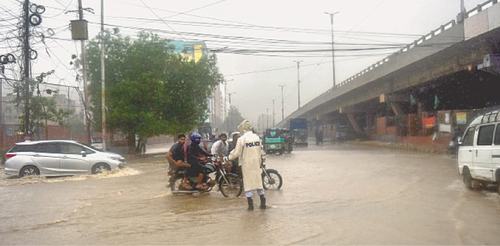
DESPITE the local bodies poll delay, discussions on how to ‘fix’ Karachi are widespread. A key factor often missed in these discussions, is that the Karachi problem has now become too unwieldy to be managed at the metropolis level and so these elections are unlikely to have any major impact.
Karachi, by most reasonable estimates, has a population of over 25 million. If this number is accurate, it would make Karachi the third largest city in the world after Tokyo and Delhi.
To put things into context, the city has a larger population than many nations including the Netherlands, Belgium and Australia to name a few. Envisaging a scenario where the entire population of the Netherlands moved to Amsterdam or all the people living in Australia decided to move to Brisbane illuminates the fundamental problem of this city.
The greatest injustice to Karachi is not the lack of developmental funds allocated to it, but the lack of development in other cities across Pakistan.
The rate of urbanisation in Pakistan is continuously increasing due to various factors and more individuals are gradually opting to move from rural areas to cities in search of higher standards of living. The question is, where will all these people go? The answer is Karachi.
Read: What is Karachi’s problem?
About 60 per cent of Sindh’s urban population lives in Karachi; similarly, a sizeable urban population from south Punjab, KP and Balochistan also live in Karachi. To make matters worse, increasing urbanisation combined with rapid population growth have resulted in a 20-year annualised average growth rate of 2.59pc; by comparison most developed cities had a growth rate of under 0.6pc in the same period.
Solving the problems of a city growth rate this high and a suffering economy is no mean feat. The key problem is that of increasing marginal cost of development as the cost of infrastructure development within an area increases with capacity. To understand this, think about the cost per vehicle of a roundabout compared to the cost per vehicle of a flyover. Although the flyover increases traffic throughput, the cost per vehicle of building it would be significantly higher.
Urbanisation of smaller towns may help address Karachi’s problems.
To further understand the economic challenges of development, take public transport as an example. A rule of thumb estimation for buses is between 0.5-1.2 buses per 1,000 people. Using this estimate, a city like Karachi would require about 12,500 buses. Karachi’s recent green line bus service, which consists of a trifling 80 buses, cost Rs35 billion. Scaling that up to 12,500 buses would result in estimated costs of Rs5.5 trillion, almost 10pc of GDP.
Similarly, looking at healthcare, Karachi’s four major public hospitals have a combined capacity of 5,550 beds. A rule of thumb approximate for developed nations is between two and five beds per 1,000 people. This would mean that Karachi requires at least 60,000 hospital beds. Barring financial and logistical challenges, if one assumes this can even be achieved, then the question is, where will human capital that is required to run these hospitals reside? Given the shortage of land in Karachi will these hospitals be inside skyscrapers? And how will that impact the city’s infrastructure and ecology?
Any issue examined under a perennial lens would return the same conclusion that any stopgap solution to the city’s ailments, without addressing its rapid population growth, will result in a negative long-term outcome. The solution to Karachi’s problems is a national-level plan to reduce one-way migration and promote urbanisation of smaller towns and cities.
An already tried solution is the geographical diversification of industry. Currently, Karachi employs the largest number of industrial and private sector workers. Incentivising outward growth of these sectors to other cities would result in labour migration.
There are many examples of geographical relocation of industries due to cities becoming highly inhabitable; the northward transfer of shipping and manufacturing from London, the shift of heavy industry from Osaka to Tokyo and the shift of the manufacturing sector from Melbourne to Sydney are just some examples.
Read: Managing Karachi
Similarly, Pakistan has great potential to develop new port cities westward, redistribute financial services to developed cities and move manufacturing and small non-export industry inland.
A change like this can only be made on a national level by creating a plan that includes all stakeholders, so that its implementation is not hindered by the winds of constant political change in Pakistan.
Internal population redistribution such as this will not only reduce the burden on our sprawling megacities, but also lead to cultural diversification and acceptance in mono-cultural regions. Considering such a transformation has the potential to completely alter the sociopolitical map of the country, the question remains, which leaders would be willing to implement it?
The writer is an engineer.
Published in Dawn, August 26th, 2022