Kaleemullah Khan: India’s father of 300 mango varieties


 2
2
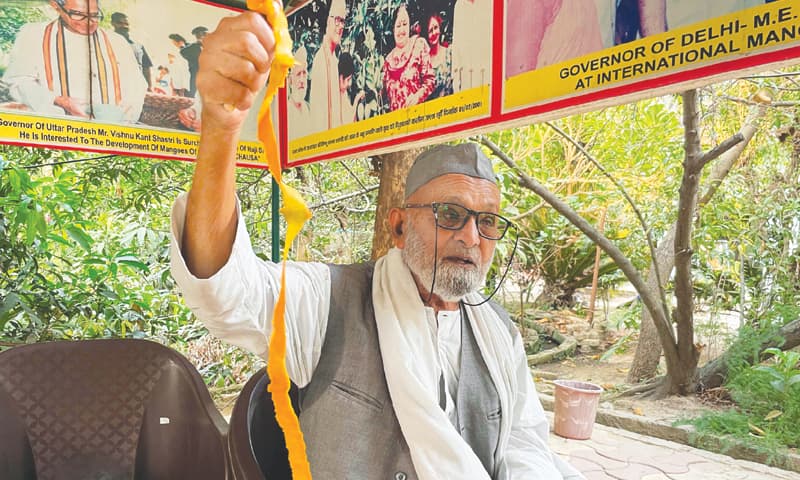

MALIHABAD: Every day, Indian octogenarian Kaleemullah Khan wakes at dawn, prays, then ambles about a mile to his 120-year-old mango tree, which he has coaxed into producing more than 300 varieties of the beloved fruit over the years.
His footsteps quicken as he draws nearer and his eyes light up as he peers closely at the branches through his spectacles, caressing the leaves and sniffing the fruits to see if they are ripe. “This is my prize of toiling hard in the scorching sun for decades,” the 82-year-old said in his orchard in the small town of Malihabad.
“For the naked eye, it’s just a tree. But if you see through your mind, it’s a tree, an orchard, and the biggest mango college in the world.” The school dropout was just a teenager when he conducted his first experiment in grafting, or joining plant parts to create new mango varieties.
He nurtured a tree to produce seven new kinds of fruit, but it blew down in a storm.
Khan has named some of his varieties after Aishwarya Rai, Sachin Tendulkar and PM Modi
But since 1987, his pride and joy has been the 120-year-old specimen, source of more than 300 different types of mango, each with their own taste, texture, colour and size, he says. One of the earliest varieties he named “Aishwarya” after Bollywood star and 1994 Miss World beauty pageant winner Aishwarya Rai Bachchan. To this day, it remains one of his “best creations”.
“The mango is as beautiful as the actress. One mango weighs more than a kilogram (two pounds), has a tinge of crimson to its outer skin and it tastes very sweet,” Khan said.
Others he named in honour of Prime Minister Narendra Modi and cricket hero Sachin Tendulkar. Another is “Anarkali”, or pomegranate blossom, and has two layers of different skin and two different pulps, each with a distinctive aroma.
“People will come and go, but the mangoes will remain forever, and years after, whenever this Sachin mango will be eaten, people will remember the cricketing hero,” said the father of eight.
Famed fruit
Standing nine metres (30 feet) tall, his treasured tree has a stout trunk with wide-spreading, thick branches that yield a pleasant shade against the Indian summer sun.
The leaves are a patchwork of different textures and smells. In some places, they are yellow and glossy, and in others, a dark, dull green. “No two fingerprints are the same, and no two mango varieties are similar. Nature has gifted mangoes with traits like humans,” Khan said.
Published in Dawn, July 21st, 2022