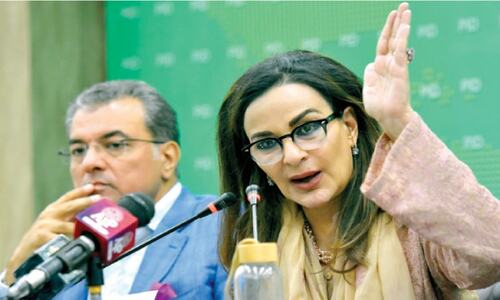
Sherry Rehman calls for mechanism to transition to clean energy


ISLAMABAD: Pakistan is facing severe shortage of energy which is why there is a need to formulate a viable mechanism so it can rely on clean energy, Minister for Climate Change Sherry Rehman said on Tuesday.
“Coal and carbon intensive generation plants dominate the country’s power grid and moving away from them is the only option we have if we want a sustainable future, without compromising on the country’s financial and economic integrity,” Ms Rehman said while presiding over an inter-ministerial meeting held to discuss clean energy transition with Asian Development Bank (ADB) Country Director Yong Ye.
The minister outlined the need to generate both resources and mechanisms for a just energy transition that should be replicable and scalable to Pakistan, adding that it was essential both for public consumption and climate commitments, as well as in reducing reliance on expensive, imported, dirty energy to work on a framework and roadmap to such a transition.
She requested the ADB country director to move forward on conducting a ‘Transition Assessment for Energy Transition Mechanism (ETM)’ to help Pakistan accelerate the move towards clean power.
Mr Ye stressed that retirement of dirty energy power plants would not only decrease significant carbon emissions but also unlock investments in renewable energy, storage, electric vehicles and other clean technologies.
“During COP26, 90pc of the world had put forward net zero targets but Pakistan was not one of these countries. Carbon neutrality is a state of net zero emissions which can only be achieved by cutting down greenhouse gas (GHG) emissions to as close to zero as possible. While net zero pledges are commendable, they are not enough as Pakistan bears the burden of carbon emissions by rich countries. Climate catastrophe is here now and we have to collectively come together to take up this challenge,” the ADB official said.
It was agreed that an initial transition assessment, to be carried out by the ADB, would lead to a much larger feasibility study for a High-Carbon Replacement Fund (HCRF).
Pakistan should not be burdened with the financial costs of the transition in this climate emergency, Ms Rehman said, adding that Pakistan was on the frontline of the climate catastrophe as we brace for floods, endure heatwaves and watch GLOF incidents unfold throughout northern parts of the country.
“We produce less than 1pc of GHG emissions, but our economy is exposed to high levels of climate costs to the tune of 9.2pc of our gross domestic product (GDP), so we need all pledges to assist our country in transitioning into renewable energy to be realised. It is going to be an extremely expensive, complex and difficult process,” the minister highlighted.
Richer countries are yet to make that decisive transition, she said, adding that it was everyone’s responsibility to share the costs of de-carbonisation.
Later, she appreciated multilateral institutions like the ADB in pledging to assist Pakistan in building capacity at technical and financial levels.
Published in Dawn, July 6th, 2022