

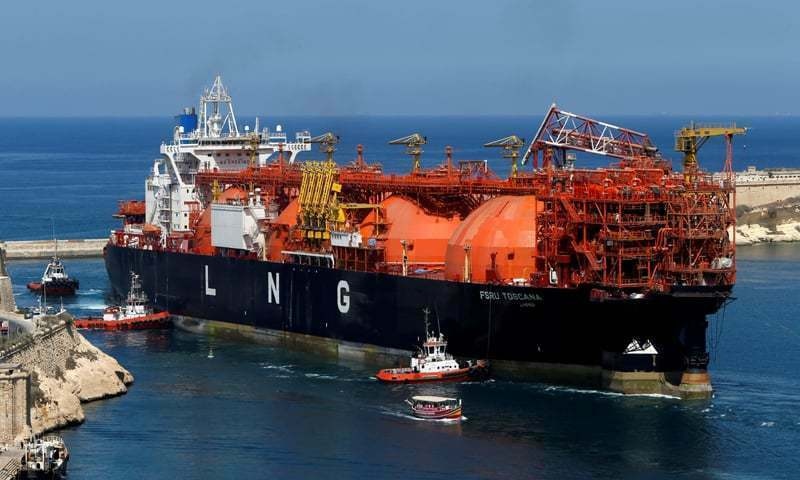

ISLAMABAD: Pakistan has decided not to accept the single bid for LNG cargo it received for delivery in July at a record $39.8 per million British thermal unit (mmBtu) for being too expensive and unaffordable amid rising electricity prices and shortages.
Therefore, Pakistan would have again only 8 LNG cargoes of about 800 million cubic feet (mmcfd) in July — all under Qatar’s long-term contract. On the last day for bidding on Thursday, Pakistan did not get any bids for three LNG slots for first three weeks of July but received the highest ever rate for another slot for the last week of July as European customers suck spot market quantities to make up for Russian supply disruption.
State-run Pakistan LNG Ltd (PLL) had floated a tender on June 16 for four cargoes — one each in the first, second and two in the last week of July. No bidder came up for July 2-3, July 8-9 and July 25-26 delivery windows.
This was the third attempt by PLL to have an LNG cargo in the first week of July that remained fruitless. The earlier two tenders issued on May 31 and June 7 had attracted two and one bidders, respectively but none were technically responsive and hence bids were scrapped.
The only bid this time for July 30-31 came from QatarEnergy Trading at a prohibitively record high price of $39.8 per mmBtu. “The bid was too expensive and we have not awarded the tender. We have 24 hours under the bid conditions to issue a rejection letter,” an official said, adding it would be better to go for loadshedding.
The highest-ever bid that Pakistan accepted since it started LNG imports in 2015 was at $30.65 per mmBtu in November 2021.
Informed sources said the suppliers in the spot market besides the producers in the Middle East had been influenced by the US government to ensure maximum LNG supplies to the European countries, already lifting the commodity at any price to meet energy shortages caused by supply disruptions from Russia.
The regasified LNG prices in Pakistan, despite a large majority of cargoes coming from cheaper long-term contracts, have already gone up by 40pc to $22-24 per mmBtu in recent months owing to a string of spot cargoes procured by the new unity government in the first month in office to meet energy shortages.
Coupled with a surge in coal and oil prices, these LNG rates have pushed up electricity fuel costs by over 100pc as evident from Rs7.95 per unit additional monthly adjustments claimed by ex-Wapda distribution companies and over Rs11.38 per unit by K-Electric for next month.
The state-run LNG importers – PSO and PLL — are better off with even expensive imports because they earn windfall on account retainage and margins at the rate of 3.22pc and 3pc, respectively, which goes up with higher import prices.
Due to the Russia-Ukraine situation and international demand-supply dynamics, the price of spot LNG cargoes has gone up, apparently making it unaffordable to Pakistan, enhancing the liquidity requirement of LNG importers. Besides LNG import, PSO is also importing furnace oil to meet the demand of the power sector, which is adding to its financial constraints.
PSO and PLL have placed their estimated liquidity requirement during the summer months under which PSO would need a total of Rs1.7 trillion at the rate of Rs427bn in June, Rs445bn in July, Rs413bn in August and Rs414bn for September for both LNG and furnace oil.
PLL, on the other hand, has sought a total of Rs278bn for four months including Rs98bn during the current month, Rs44bn in July, Rs80bn in August and Rs56bn in September.
Published in Dawn, June 25th, 2022




























