KARACHI: Uncertainty for foreign investors remained high in May as the outflows from domestic bonds reached over $99 million against an inflow of just $15m in the treasury bills (T-bills).
The returns on T-bills and Pakistan Investment Bonds (PIBs) are highly attractive for investors, but the country is paying a heavy price for the political crisis and carrying a flood of uncertainties.
April of this fiscal year (FY22) showed no inflow during the month. The previous month, March, was also almost empty. Before the political crisis started, Pakistan received over $25m in inflows in T-bills and $5m in PIBs in February.
May was the third month in a row showing no foreign investment for PIBs, a domestic long-term bond.
However, short-term bonds and T-bill inflows were also low during the month. The T-bill inflows were unimportant due to the heavy outflow.
The data shows that the T-bills received $14.9m during the month of May, while the outflow was $53.1 million. The T-bills offer up to a 14.75 per cent return, which is highly attractive for a short-term investment, but the high yields offered could not attract foreign investors.
The long-term PIBs could not attract a single dollar in May while they were empty in March and April too. It shows that no foreign investor was ready to take the risk of investing in long-term bonds.
Under the current political scenario and with depleting foreign exchange reserves, the high-yield domestic bonds have failed to attract foreign investors. The foreign exchange reserves of the State Bank of Pakistan and the country remained half of the total reserves at the beginning of FY22.
The last auction of T-bills held on May 18 showed that the cut-off yield for three, six and 12 months tenure was 14.49pc, 14.7pc and 14.75pc, respectively.
Similarly, the PIB returns were 14.7pc and 13.19pc for three and five years, respectively.
During the 11 months of FY22, the total outflows were $1.874 billion, against an inflow of $703.8m. The cumulative net flow during this period was $1.170bn.
Bankers believe the current rates of T-bills and PIBs are highly attractive and could attract much higher amounts once a deal is struck with the International Monetary Fund (IMF). One of the preconditions for increasing petroleum prices was accepted by the government while more could be in the pipeline.
Sources in the financial sector believe that the resumption of IMF loans could open windows for more inflows like the rollover of Chinese $2.3bn. The oil price hike that indicated that the government accepted the IMF’s preconditions signalled to the market about the future relations with the IMF, resulting in a dollar depreciation of Rs2.25 in a single session on Friday.
Though most of the analysts were of the view that the dollar deprecation was not sustainable in the absence of any solid support for the foreign exchange reserves of the country, there is still hope for improvement in the exchange rate attached to the higher inflows.
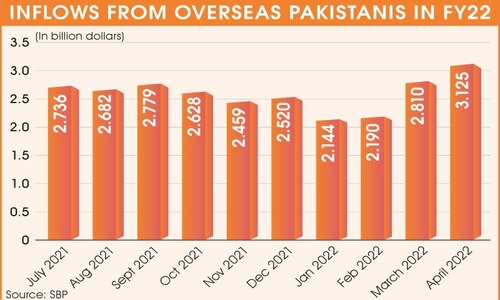
The government slashed the list of importable items while the exports increased and remittances set new records, it could finally reduce the trade deficit and current account deficit.
Published in Dawn, May 29th, 2022