Thar, a new Netflix release, belongs to a distinct subversive genre. Long shots of desolate desert. A grisly murder, a severed ear. A fatigued cop, Surekha (Anil Kapoor), about to retire in a few months. And then, a stranger enters the village, a city slicker named Siddharth (Harshvarrdhan Kapoor), a seller of antiques in Delhi.
The year is 1985, the place Munabao, a hamlet in Rajasthan. Deceitful men, ambiguous motives, a forlorn landscape — this is a Western winking at noir or country liquor-sniffing No Country for Old Men.
Clocking in at 109 minutes, Thar is more mood than plot. There are two parallel murders: one of a family and the other of an individual. It alternates between the lives of Surekha and Siddharth: a beaten old guard, who remained a sub inspector his entire life, and a reticent young man on a disturbing mission.
The movie isn’t about who committed the main murder — we find out early — but why. The reason is revealed in the climax. Thar, then, primarily fills in the rest of the blanks — not through plot, but the characters. Surekha is pleasant company; the film conveys his life’s tenor and tone with sufficient finesse.
For a film centred on horrific depravities, Thar is quite sheepish about most scenes of violence
He says in an early scene that in the old days, dacoits were “rebels from the so-called lower castes; they were principled, unlike these people” — his junior Bhure (Satish Kaushik), belonging to a marginalised caste, listens quietly. When Surekha enters the house of a young woman (Fatima Sana Shaikh), Bhure stays out. Surekha has enough problems of his own — a still life, a servile life — and his wife has listened to them all; she dozes off midway at times, leaving her husband alone with his monologue.

These bits feel fascinating and significant — but only till a point. Because Thar’s filmmaker, Raj Singh Chaudhary, succeeds in sprinkling details but struggles to connect them. A subplot like Surekha’s also has a hidden pitfall: it is realistic to the point of being stagnant. Or at least stagnant enough that it lacks a riveting arc or lasting socio-political engagement. The net result is a slow burn culminating into, well, not much.
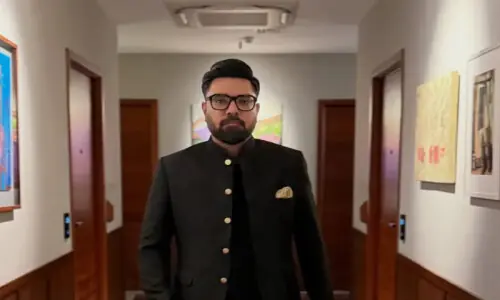
Then there’s Siddharth, a puzzle in a puzzle. Like many compelling characters, he’s marked by a curious contradiction. He doesn’t talk as much; his actions do — or scream rather. One by one, young men in the village start to vanish. Siddharth has locked them up in a rundown fort, inflicting barbaric torture on them. Such a schism makes you crave character details, but Harshvarrdhan reveals nothing, first eliciting intrigue, then frustration.
Unlike other star kids, Harshvarrdhan isn’t known for scene-chewing bravado but a slow simmer. It was a style that looked refreshing in the earlier years, but in 2022, it feels like a shtick — a performance of a performance.
Worse, that approach backfires, as Siddharth doesn’t look menacing, or effective, in gory scenes. His character is so inert that he ossifies the film, shutting out possibilities and surprise. Instead of subtle tonal variations — a through-line connecting Siddharth’s ‘normal’ and unhinged selves — Harshvarrdhan plays him in two distinct modes, embodying (not improving) his conceived insipidness.
For a film centred on horrific depravities, Thar is quite sheepish about most scenes of violence, cushioning the blows by distracting background music. They are present in both kinds of torture — by Siddharth and Surekha — making the diluted impacts an in-house style. That isn’t the case, however, when the victim is a woman. The violence, then, becomes more ‘agile’ and confident and disturbing, making you suspicious about the stark change in tone.
What leaves no scope for doubt, though, is its climax. It’s so stale and closed and easy that it feels quite fittingly that the filmmakers had run out of ideas. Towards the end, Surekha is where he was: contemplating an uncertain future, much like the sheriff in No Country for Old Men.
The only difference is that the poetic coda of Tommy Lee Jones’ character bookended a modern masterpiece. Here, the climactic shock (and Surekha’s parallel defeat) reminds you of a lazy pun: a ‘cop out’.
By arrangement with The Wire
Published in Dawn, ICON, May 15th, 2022