105
105

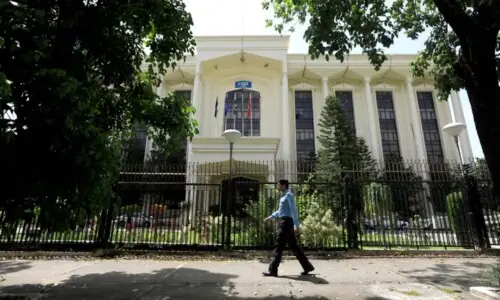
ISLAMABAD: The Islamabad High Court (IHC) has clarified opening its doors late on Saturday, when the fate of a no-trust resolution against former prime minister Imran Khan hung in the balance and rumours were rife that Mr Khan might de-notify the army chief in his attempt “to play till the last ball”.
Meanwhile, a petition was also filed in the IHC on Saturday night, asking the court to restrain Mr Khan from de-notifying Gen Qamar Javed Bajwa as chief of the army staff.
Another petition by the Supreme Court Bar Association (SCBA) requested the court to avert a constitutional crisis and implement the Supreme Court’s April 7 order.
“The filing of petitions late in the evening on April 9, 2022, has been misreported and queries have been raised whether petitions can be presented after the notified court timings,” the IHC said in a statement issued on Monday.
IHC clarifies why its doors opened late at night on April 9
In its statement, the IHC referred to two circulars issued on Nov 11, 2019 and Feb 10, 2021 that prescribed “the manner of presentation of petitions after court timing”.
Through these circulars, the IHC notified that in case of an imminent threat to the life or liberty of a citizen or any other important matter, the registrar office can receive the petition and transmit it to the chief justice even after court timing.
“As a constitutional court, the Islamabad High Court has ensured that cases relating to extreme urgency are presented at any time after the notified timings,” the high court said, adding: “The honourable chief justice, if satisfied that there exists extreme urgency, may order fixing of the case at any time.”
Explaining the April 9 events, the IHC said the SCBA president approached the court and inquired about filing a petition under Article 187 of the Constitution.
The IHC statement then referred to the petitions, including a “pre-emptive” constitutional petition that sought to restrain the then premier from de-notifying the army chief.
“In the meanwhile, certain other petitions were presented and they were transmitted to the residence of the honourable chief justice, who was satisfied that neither the petitions warranted initiation of proceedings nor required passing of a judicial order,” it said.
It is, therefore, clarified that in the light of the above-mentioned circulars, a petition regarding extreme urgency could be presented at any time after the notified court timings and it could also be fixed for hearing subject to the satisfaction of the chief justice that circumstances exist for doing so, the court said.
Published in Dawn, April 12th, 2022